
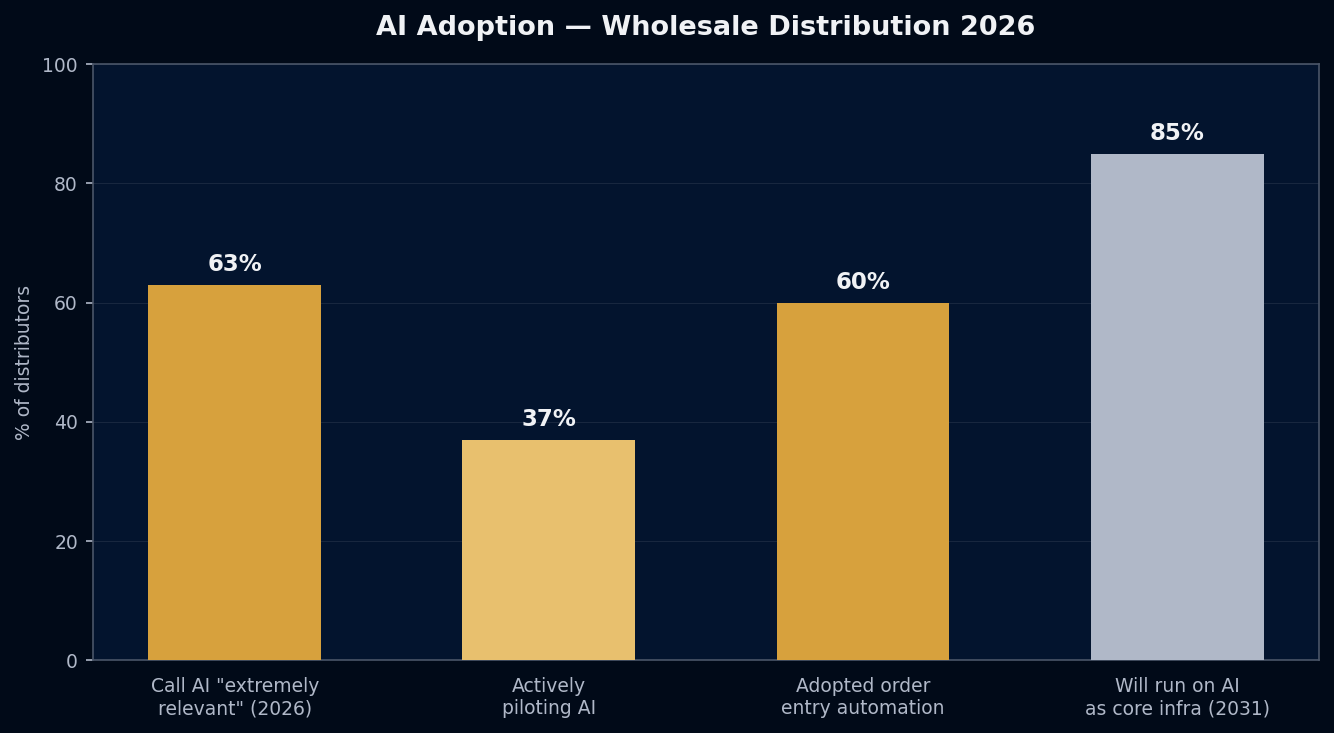
Three statistics from the 2026 wholesale distribution data tell a story that the individual numbers obscure:
63% of wholesale distributors describe AI as “extremely relevant” to their business (Applied AI for Distributors 2026).
85% will classify AI as core infrastructure — as standard as ERP — by 2031 (same source).
68% of those already running AI cannot measure its ROI (Applied AI for Distributors 2026).
Read together: an industry that believes AI is critical, is on track to universal adoption within five years, and mostly cannot prove whether its current AI investments are generating value.
The gap is not between those who have AI and those who don’t. It’s between those who are getting measurable value from it and those who are running it as an overhead without a return line.
The 63% Number
“Extremely relevant” is a strong signal for an industry that tends toward operational conservatism. Wholesale distribution — which runs on thin margins, high volume, and relationship-based sales — is not historically an early-technology adopter category. The 63% “extremely relevant” figure in 2026 represents a significant shift from where the same question would have been answered in 2022 or 2023.
What’s driving the shift is not abstract optimism about AI capabilities. It’s specific operational benchmarks from early adopters that have become common knowledge:
- 90% reduction in order processing time from AI order entry automation (WizCommerce, 2026)
- 65% average AI resolution rate for customer support queries (Gleap, 2026)
- 23% higher margins on AI-driven product recommendations (Applied AI for Distributors 2026)
These are not projections. They’re operating numbers from businesses in the distribution sector. When competitors are processing 500 purchase orders per day with the same headcount it used to take to process 50, “extremely relevant” is the appropriate reaction.
The 85% Projection
By 2031, 85% of wholesale distributors will run AI as core operational infrastructure — not a pilot, not a supplementary tool, but the same category as ERP, WMS, and CRM.
The 20% compound annual growth rate in AI adoption that this projection reflects is consistent with historical technology adoption curves for operational software in B2B markets. ERP adoption followed a similar S-curve in the 1990s and early 2000s. The first movers saw 3–5 years of competitive advantage before the technology became table stakes.
The implication is directional rather than precise. Whether the actual adoption curve hits 75% or 90% by 2031 matters less than the shape: B2B distribution is in the early majority phase of AI adoption. The window where AI implementation provides a genuine competitive advantage rather than just meeting the baseline is 2–3 years, not 5–10.
The 68% Problem
The 68% who cannot measure AI ROI have a specific failure pattern in common: they deployed without establishing baselines and without defining what success looks like in measurable terms.
This is not an unusual pattern in B2B technology deployment. It happened with CRM adoption, ERP implementation, and marketing automation. The technology gets purchased, deployed, and announced. Six months later, nobody has a clean before-and-after comparison.
The cost of the measurement gap is not just not knowing whether the AI is working. It’s running the AI with the wrong configuration and not knowing it’s wrong. An AI support implementation with a 25% resolution rate and a 30% resolution rate look the same from the outside if nobody is measuring resolution rate. One is generating savings; one is generating slightly more automated escalations. Without the measurement, there’s no basis for the configuration change that would push the rate to 65%.
The four metrics that close the gap — resolution rate, cost per query, PO exception rate, first-response time — are covered in detail in the measurement framework article. The baseline capture protocol takes 2–3 hours before go-live. That 2–3 hours is the difference between being in the 32% who can prove ROI and the 68% who can’t.
What Separates the 32%
The distributors who can measure their AI ROI share structural characteristics that are replicable:
They deployed for a specific problem, not for AI in general. “We’re deploying AI to reduce cost-per-support-query from €9 to under €2” is a different project than “we’re implementing AI.” The specific problem framing forces the measurement framework into existence.
They captured a baseline before go-live. Even a rough baseline — previous quarter’s support ticket volume, handling time, cost — is sufficient for a 90-day ROI comparison. Perfect data is not required. Some data is required.
They assigned ownership. The AI tool has an owner in the organization: a specific person responsible for its performance, its configuration updates, and its measurement reporting. Without ownership, AI tools drift — the knowledge base stops being updated, the escalation routing stops being refined, the exception rate creeps up without anyone noticing.
They started narrow and scaled. They picked one workflow, automated it completely, measured it, and then moved to the next. The 96% touchless invoice processing benchmark (Canals) was not achieved by automating all workflows simultaneously. It was achieved by getting one workflow right, validating it, and building systematically.
The Practical Starting Point for 2026
For a wholesale distributor who has not yet implemented AI — or who has deployed something that isn’t generating measurable results:
- Identify your highest-volume manual process (usually order entry or customer support).
- Pull 90 days of data on that process: volume, time spent, error rate, cost.
- Define what “working” looks like: target exception rate, target resolution rate, target cost per transaction.
- Select a single tool that addresses that specific process.
- Deploy with baseline documentation and a 30-day review date.
That sequence converts “we’re thinking about AI” into “we deployed AI and here’s what it’s returning” — which is the position that matters competitively in 2026.
AHoosh implements AI operations for B2B distributors — with measurement frameworks built in. ahoosh.ai/contact | Daily distribution intelligence at t.me/ahooshai