
The 23% higher margins reported for B2B distributors using AI product recommendations (Applied AI for Distributors 2026) come from a mechanism that is simpler than it sounds.
The AI is not making complex predictions about buyer intent or running sophisticated demand forecasting. It’s doing collaborative filtering on order history: identifying which products co-purchase — which SKUs are frequently ordered together, which products tend to follow each other in a customer’s order sequence — and surfacing these patterns at the point of ordering.
“Customers who order Product A also frequently order Product B” is the same logic Amazon’s consumer recommendation engine runs. In a B2B distribution context, with order histories that span years and hundreds of SKUs, the patterns are consistent and commercially significant. The margin improvement comes from customers buying adjacent SKUs they would have bought anyway — but with fewer friction steps between recognition and purchase.
Why are B2B co-purchase patterns such strong signals?
B2B purchasing is structural, not impulsive: a distributor stocking a product line also needs its accessories, a manufacturer ordering a component also needs its consumables. These patterns repeat because they are tied to the buyer’s operational requirements, not personal taste. That makes B2B co-purchase recommendations more predictable and more likely to convert than consumer “people also bought” suggestions, because the buyer already knows they need both items.
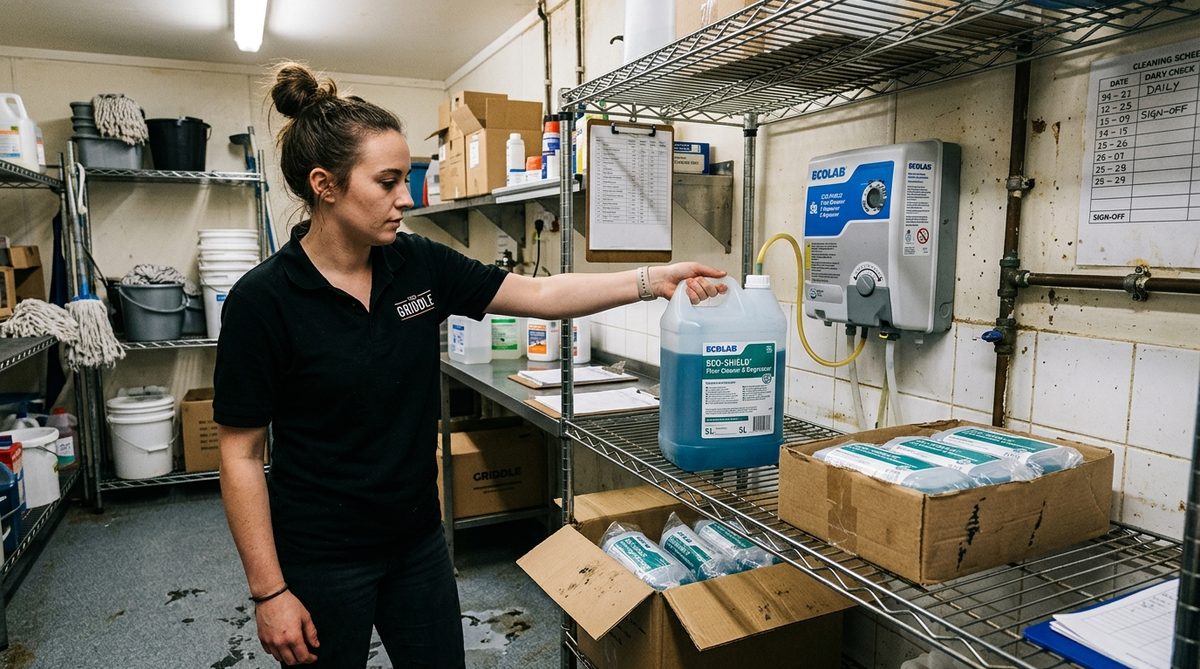
B2B purchasing is more predictable than consumer purchasing. A restaurant that orders a specific cleaning product also orders the matching dispensers.
A manufacturer that orders a component also orders the consumables that component uses. A distributor that stocks a product line stocks the accessories.
These patterns are not random. They’re structural — tied to the operational requirements of the buyer’s business. The B2B buyer who is ordering Product A has a near-certain need for Product B that they may simply not think to add to the order. The recommendation surfaces the need at the right moment.
The conversion rate for AI product recommendations in B2B contexts is substantially higher than in consumer contexts for this reason. A B2B buyer who sees “customers ordering [specific industrial cleaner] also order [specific dispenser cartridge]” recognizes the relevance immediately — because they know their operation has both requirements. The recommendation is not upsell; it’s a reminder.
What data do you need for AI product recommendations?
Collaborative filtering needs three things to work reliably: at least 1,000 order line items across the catalog, at least 6 months of order history so patterns aren’t seasonal noise, and broad coverage of the product catalog in that history. Below those thresholds the patterns are too sparse to trust. Most B2B distributors operating more than a year already have this data sitting in their ERP, just never pulled for this purpose.
Collaborative filtering requires order history data to work. The minimum viable dataset:
- Volume: At least 1,000 order line items across the product catalog. Below this threshold, the patterns are too sparse to generate reliable recommendations.
- History: At least 6 months of order history. Patterns that appear in 3 months of data may reflect seasonal anomalies rather than structural co-purchase behavior.
- Coverage: The recommendation quality depends on how well the order history covers your product catalog. If 20% of your SKUs have never been ordered by the customer cohort you’re analyzing, the recommendations will be limited to the 80% with history.
Most B2B distributors who have been operating for more than a year have sufficient order history. The data exists in the ERP — it usually just hasn’t been pulled for this purpose.
How do you implement AI recommendations at different scales?
Small distributors (under 200 customers) can identify their top co-purchase pairs with a manual SQL export and pivot table — no AI tool needed, 4 to 8 hours of work. Medium distributors (200 to 1,000 customers) use tools like Recombee or Barilliance, integrated with the ordering portal, for €100 to €500 a month. Larger distributors run enterprise engines such as Algolia, which also factor in inventory and margin data.
For small distributors (50–200 customers, <€1M annual revenue):
A simple SQL query on your ERP order history can identify your top 20 co-purchase pairs manually — no AI tool required. Export the order lines, pivot by customer and product, identify which products co-appear most frequently. This produces a manual recommendation list that your sales team can use in customer conversations and order confirmations.
Cost: 4–8 hours of analysis time. ROI: any sales team using the co-purchase data in customer conversations will generate additional line items on existing orders.
For medium distributors (200–1000 customers, €1M–€10M annual revenue):
Tools like Recombee, Barilliance, or custom Python implementations with collaborative filtering run on your order history and generate automated recommendations. These integrate with your ordering portal or ERP to surface recommendations at the point of order entry.
Implementation time: 4–8 weeks. Cost: €100–€500/month depending on tool and order volume.
For larger distributors:
Enterprise recommendation engines like Algolia (which has a B2B distribution tier), or a custom-built solution using the same collaborative filtering logic at scale. These also incorporate inventory availability and margin data into the recommendation logic — not just co-purchase frequency.
Where does the 23% margin improvement actually come from?
The margin gain is not mainly about pushing higher-margin products — it comes from added line items on orders that were already happening. Each extra item carries no additional acquisition, logistics, or account-management cost, so the incremental revenue flows almost directly to gross margin. The effect compounds across hundreds of customers each adding one or two extra line items per order, which is where the 23% average comes from.
The margin improvement from recommendations is not primarily about selling higher-margin products (though recommendation logic can be configured to prioritize them). It’s about increased basket size and reduced per-unit cost to serve.
When a customer adds an additional line item to an existing order:
- No additional acquisition cost (the customer is already ordering)
- No additional logistics cost (the item ships in the same delivery)
- No additional account management cost (the relationship is already in place)
The incremental revenue from the added line item flows directly to gross margin with very low incremental cost. At scale — across hundreds of customers, each adding one or two incremental line items per order — the margin effect is significant.
The 23% margin improvement is an average across implementations. The improvement is higher for distributors with large, underutilized product catalogs where customers are buying a fraction of what they could be buying from the same supplier. It’s lower for distributors where catalog depth is limited and customers already have high catalog coverage.
Which recommendation configuration should you start with?
Start with frequency-based recommendations: surfacing whatever items are most commonly bought together. They’re transparent, easy to explain to customers (“other customers ordering this also order that”), and produce the highest relevance out of the box. Margin-weighted recommendations, which prioritize higher-margin co-purchase candidates, and inventory-aware recommendations, which hide out-of-stock items, are configuration layers to add only after the frequency baseline is validated.
Recommendation engines can be configured to optimize for different objectives:
- Frequency-based: surface the items most commonly co-purchased
- Margin-weighted: surface items with higher gross margin among the co-purchase candidates
- Inventory-aware: deprioritize items currently out of stock or on allocation
For a B2B distributor deploying this for the first time, frequency-based recommendations are the correct starting configuration. They’re transparent, easy to explain to customers (“other customers ordering this also frequently order that”), and produce the highest recommendation relevance.
Margin weighting and inventory awareness are configuration layers to add after the frequency baseline is validated.
Is AI product recommendations right for your operation?
It’s a strong fit for distributors with 50-plus SKUs, 100-plus customers, and more than 6 months of order history — the pattern data already exists, the only question is whether anyone is using it. It’s a weak fit for distributors with fewer than 20 SKUs, where co-purchase combinations are already obvious to the sales team and don’t need algorithmic surfacing. Catalog depth and order volume decide the answer, not company size alone.
Strong fit: distributors with 50+ SKUs, 100+ customers, and order histories longer than 6 months. The pattern data exists; the question is whether anyone is using it.
Weak fit: distributors with a very narrow product catalog (fewer than 20 SKUs) where almost all co-purchase combinations are already obvious to the sales team and don’t need algorithmic surfacing.
The starting question: what is your average number of line items per order? If customers are consistently ordering 3–5 items when your catalog is 200 SKUs, there’s an untapped recommendation opportunity in the data.
AHoosh implements AI recommendation systems for B2B distributors. ahoosh.ai/contact