
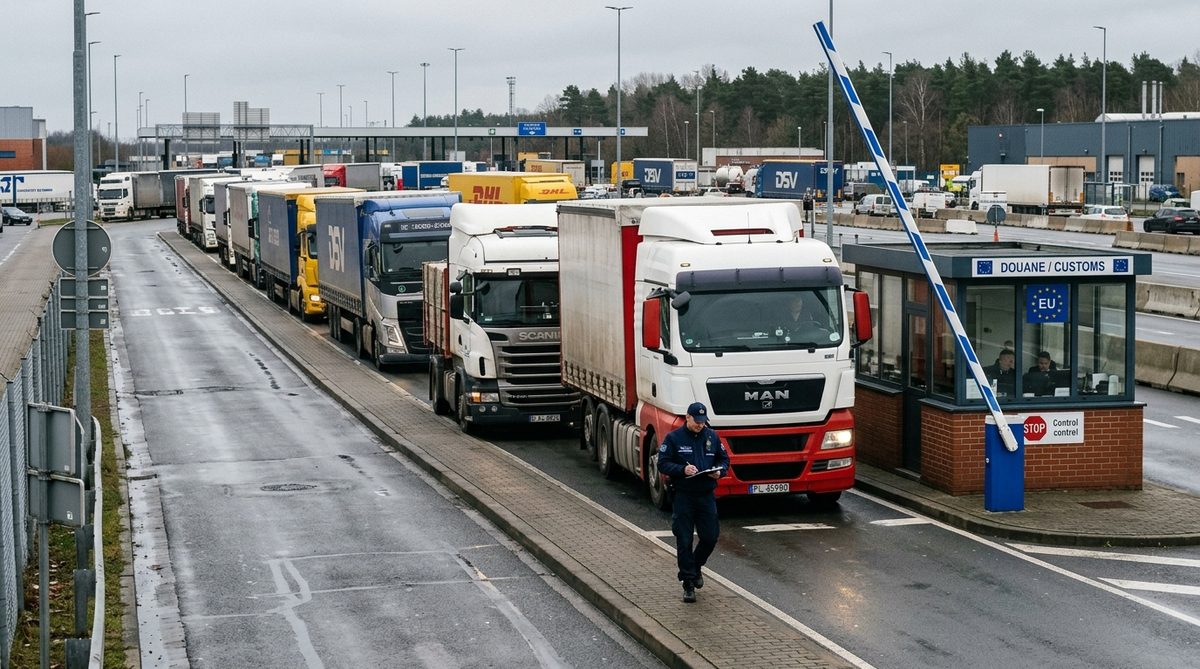
Trade compliance is the part of cross-border business that small companies assume is only for large corporations with legal departments — right up until a bank freezes a payment, customs holds a shipment, or a routine check turns up a counterparty they should never have dealt with. Compliance is not optional at any size. The rules apply to a two-person exporter exactly as they apply to a multinational; the difference is that the multinational has a team watching them and the small business often does not.
The good news is that the core of trade compliance for a small B2B business is not complicated. It is a handful of checks done consistently, a few documents kept correctly, and a habit of pausing before the deal rather than after. Most compliance failures at this scale are not sophisticated crimes — they are ordinary businesses that simply never built the routine and got caught out by a rule they did not know applied to them.
This is a plain-language guide to the basics: what you actually have to check, what happens when you skip it, and how to build a compliance routine that fits a small business rather than a corporation.
Sanctions and Restricted-Party Screening — The Non-Negotiable Check
Screening who you deal with is the first and most important habit.
Sanctions law prohibits dealing with certain countries, entities, and individuals — and “I didn’t know” is generally not a defence. The penalties for breaching sanctions are severe and fall on the business, not just the person who signed the order. For a European business, this means checking against the relevant restricted-party lists before you commit to any new counterparty.
- Screen every new customer, supplier, and end-user against the applicable sanctions and consolidated lists before the first transaction. The EU maintains a consolidated list of sanctions that is the natural starting point for EU-based businesses.
- Screen the whole chain, not just the name on the invoice. The buyer may be clean while the ultimate end-user or the intermediary is not. Ask who the goods are really for.
- Re-screen periodically, not just once. Lists change, and a counterparty that was clear last year may not be now.
- Keep a record that you screened. A dated note showing you checked before the deal is your evidence of good faith if a question ever arises.
This applies with particular force to trade touching high-risk regions. If any part of your business brushes against sanctioned markets, read our sanctions map for EU B2B operators before quoting anything — the exposure often sits one step removed from the party you are actually invoicing.
When in doubt, stop and ask.
If screening surfaces anything ambiguous — a partial name match, an unclear end-user, a jurisdiction you are unsure about — the correct move is to pause and seek qualified advice, not to proceed and hope. The cost of a compliance lawyer’s hour is trivial against the cost of a sanctions breach.
Product Classification — Knowing What You Actually Ship
Every product has a code, and the code drives the rules.
Physical goods crossing borders are classified under a harmonised system of codes. That classification determines the duty rate, the documentation required, and — critically — whether the item is controlled. Getting it wrong is not a paperwork nicety; it can mean underpaid duties (a debt customs will pursue) or shipping a controlled item without a licence.
- Determine the correct commodity code for each product you trade. The World Customs Organization Harmonized System is the global backbone that national tariff schedules build on.
- Check for dual-use status. Some ordinary-seeming goods — certain electronics, chemicals, software, and components — are “dual-use,” meaning they have both civilian and potential military application and require an export licence to certain destinations. This catches out small businesses constantly, because the product looks harmless.
- Know your product’s origin. The country of origin affects duties and eligibility under trade agreements, and it must be declared honestly.
If you are unsure of a classification, national customs authorities offer binding rulings that give you legal certainty on how a product is treated. For a small business trading a stable range of products, classifying each item once and recording it is a modest, one-time effort that prevents recurring problems.
Documentation — The Paperwork That Actually Moves the Goods
A shipment is only as good as its documents.
Customs and banks act on paperwork, not on your intentions. Incomplete or inconsistent documents are a leading cause of held shipments, delayed payments, and unexpected costs. The core set for most B2B trades:
- Commercial invoice — the definitive statement of what is being sold, to whom, at what value, on what terms. It must be accurate; undervaluing to reduce duty is fraud.
- Packing list — what is physically in each carton or pallet.
- Transport document — the bill of lading (sea) or air waybill, which also functions as evidence of the contract of carriage and, in some cases, title.
- Certificate of origin — where required to claim preferential duty or satisfy the destination’s rules.
- Any product-specific certificates — conformity, health, safety, or licence documents the goods require.
Two disciplines prevent most documentation trouble:
- Consistency across documents. The description, quantity, value, and parties must match on every document. A mismatch between the invoice and the transport document is exactly what triggers a customs query or a rejected letter of credit.
- Terms stated explicitly. The delivery term (the Incoterm) and payment term belong on the paperwork, not just in an email. Which party bears which cost and risk should never be ambiguous — our guide to Incoterms for EU–Iran trade shows how the shipping term shapes who is responsible for what at each stage.
Keep copies of everything, organised by shipment, for the retention period your jurisdiction requires — typically several years. If a question arises later, reconstructed records are worth far more than memory.
Build a Right-Sized Compliance Routine
Compliance for a small business is a checklist, not a department.
You do not need a compliance officer. You need a short, written routine that runs the same way on every deal, so nothing depends on remembering. A workable minimum:
- Before any new counterparty: screen against sanctions lists, confirm the end-user, and record that you did. No screening, no deal — make it a hard rule.
- For each product: classify it once, note the code, flag anything dual-use, and record the origin.
- For each shipment: run a documentation checklist confirming every required document is present and consistent before goods move.
- Periodically: re-screen active counterparties and check whether any rule affecting your products or markets has changed.
Write this down as an actual one-page checklist and make following it non-optional. The value is not in any single check but in doing them consistently — the failures come from the deal where someone skipped the routine because it was urgent or the buyer was “obviously fine.”
Know the limit of your own judgement.
The most important compliance skill for a small business owner is recognising the point where a question exceeds your knowledge and needs a specialist. Ambiguous sanctions matches, dual-use classification calls, and any trade touching a high-risk jurisdiction are moments to get qualified advice. This guide is a starting orientation, not legal advice — the rules are specific to your jurisdiction, your products, and your markets, and they change.
Trade compliance for a small business comes down to a few consistent habits: screen who you deal with before you deal with them, know what your products actually are and whether they are controlled, keep documentation accurate and consistent, and build a written routine so none of it depends on memory. Done consistently, this is an hour of work spread across a deal, not a department.
The businesses that get into trouble are almost never the ones that studied the rules and made a hard call. They are the ones that never built the routine and proceeded on “it’s probably fine.” Build the checklist, follow it on every deal including the urgent ones, and know when a question is bigger than your own expertise. That discipline is what keeps a small trading business out of the problems that sink it.
Sources: EU consolidated sanctions map · WCO Harmonized System