
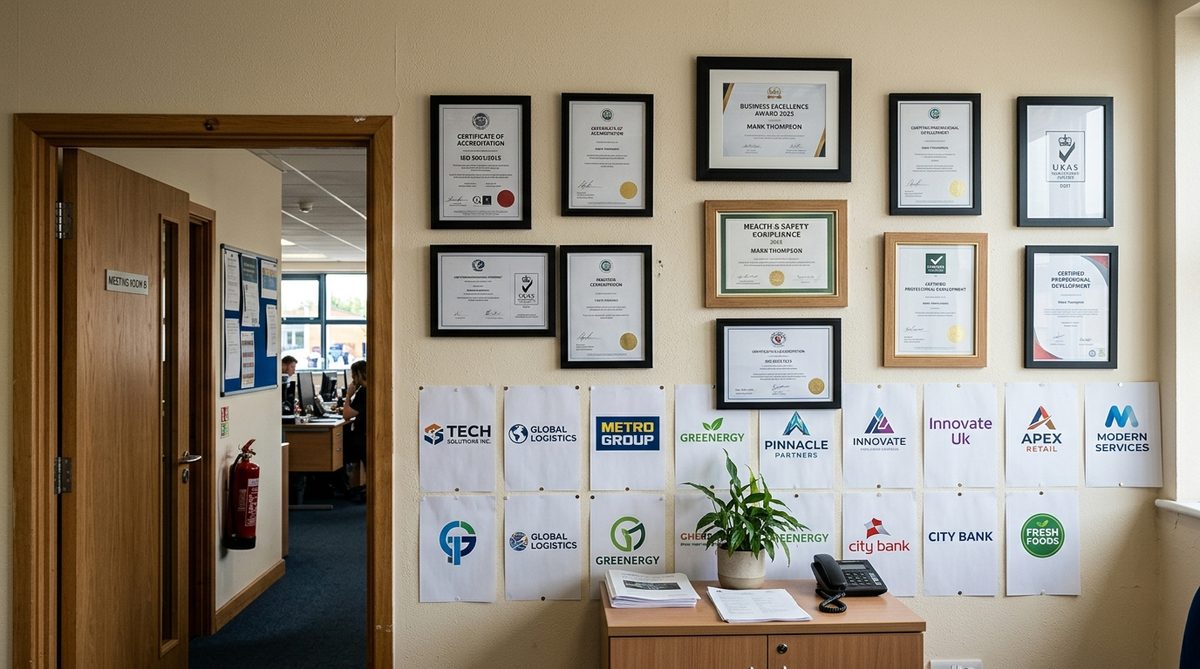
A B2B buyer landing on your website is asking one question before any other: can I trust these people with my money and my reputation? The deal might be worth thousands of euros, it will be scrutinised by their boss, and if it goes wrong it’s their name on the decision. Every element on the page either answers that question or leaves it open.
Most small-business B2B sites are built to describe what the company does. That’s necessary but insufficient. Describing your services tells a buyer what you offer; trust signals tell them whether to believe you can deliver it. A site heavy on capability claims and light on proof reads as confident but unverified — and unverified is where enquiries die.
This is not about badges and stock photos of handshakes. It’s about the specific, checkable signals that let a cautious buyer move from “this looks relevant” to “I’ll send an enquiry.” Here is what actually moves that needle for a European small-business audience.
Proof Beats Claims — Show, Don’t Assert
“We deliver excellent results” is worth nothing. A named result is worth everything.
The single biggest trust gap on small-business sites is the distance between claims and evidence. Every company says it’s reliable, experienced, and results-focused. Because everyone says it, it carries no information. Buyers have learned to skip past adjectives entirely and look for the things that are hard to fake.
Replace claims with proof:
- Named case studies — a real client, a specific problem, what you did, and a concrete outcome. “Reduced a distributor’s order-processing time from two days to two hours” beats “we improve efficiency” by an order of magnitude.
- Testimonials with attribution — a full name, role, and company. An anonymous “Great service! — J.K.” reads as invented. A quote from a named person at a named company is checkable, and checkable is credible.
- Logos you can actually claim — clients you’ve genuinely worked with, presented honestly. A small number of real ones beats a wall of tenuous associations.
- Numbers with context — “Managing catalogues for 12 distributors across three countries” tells a buyer the scale you operate at, which they map onto their own situation.
The test for any trust element: could a competitor copy-paste it onto their own site and have it be equally true? If yes, it’s a claim, not a signal. Specificity is what makes proof uncopyable. This same principle drives B2B website conversion more broadly — the pages that convert are the ones that give a buyer something concrete to believe.
Specificity Is a Trust Signal in Itself
Vague companies feel risky. Precise ones feel competent.
Beyond formal proof elements, the general specificity of your site signals competence. A company that describes exactly who it helps, exactly what it does, and exactly how it works sounds like it has done this before. A company hiding behind broad language sounds like it’s still figuring out what it is.
Where specificity builds trust:
- Who you serve. “We help B2B distributors in the EU handle currency risk on Iran sourcing” tells the right buyer they’re in the right place and tells the wrong buyer to move on — both are wins. Broad positioning that tries to serve everyone reassures no one.
- How you work. Describe your process in concrete steps. A buyer who can picture the engagement is far closer to starting it than one facing an unexplained “get in touch.”
- What it costs, or how pricing works. You don’t have to publish a full price list, but explaining your pricing model — project-based, retainer, per-SKU — removes a major source of hesitation. Silence on price reads as “expensive and evasive.”
- What you don’t do. Naming your boundaries is one of the strongest trust signals available. A firm that says “we don’t do X, for that you want Y” sounds honest in a way that a firm claiming to do everything never can.
Precision is disarming. It signals that you’ve made real choices, seen real situations, and aren’t willing to pretend otherwise to win a badly-fit client.
Reduce the Perceived Risk of Contacting You
The gap between interested and enquiring is mostly about risk, not desire.
A buyer can want your service and still not enquire, because the act of reaching out carries its own small risks: being trapped in a hard sell, looking uninformed, wasting time, or committing to something before they’re ready. Reducing these frictions converts existing interest that would otherwise leak away.
- Make the first step low-commitment. “Book a 20-minute call, no preparation needed” is easier to accept than “Request a consultation,” which sounds like a sales process. Name what happens and how long it takes.
- State what the enquiry leads to. Tell them what you’ll do with their message — “We’ll reply within one working day with an honest view of whether we can help.” Predictability lowers risk.
- Offer a no-pressure exit. Signalling that a first conversation carries no obligation removes the fear of the trap. Buyers who trust they can walk away are more willing to start.
- Show a real human. A named contact with a real photo and a direct line reads as accountable. A generic contact form to “info@” reads as a void. People trust people, not inboxes.
Every one of these is small, but they compound. The buyer who was 80% convinced needs the last 20% to feel safe, not to feel more impressed. Impressiveness gets attention; risk reduction gets the enquiry.
Get the Credibility Basics Right
Missing basics don’t just fail to help — they actively signal risk.
There’s a baseline of credibility details that buyers barely notice when present but treat as red flags when absent. For a European small business, these matter more than any persuasion technique.
- A real address and legal details. A physical address, company registration number, and VAT number where required signal a real, accountable business. Their absence makes a buyer wonder what you’re hiding — and in the EU, an imprint or legal-notice page is often a legal requirement, not just a nicety.
- A working, professional email domain. Contact from
[email protected], never a free Gmail address. A business emailing from a personal account undercuts every other trust signal on the page. - A secure site. HTTPS is expected; a “Not secure” warning in the address bar ends the visit. This is table stakes — Google treats HTTPS as a baseline and browsers flag anything less.
- A site that works on a phone. A large share of B2B research happens on mobile. A layout that breaks on a phone tells a buyer you don’t sweat details — which is exactly the wrong impression before they trust you with theirs.
- Current content. A blog that stopped two years ago or a copyright date from three years back suggests a business that may not still be operating. Signs of life are signs of reliability.
None of these win a deal on their own. But any one of them missing can quietly lose one, because a buyer weighing a purchase reads absence as risk. Getting the basics right is the price of being taken seriously at all.
Match Trust Signals to the Buyer’s Stage
Different signals matter at different points in the decision.
A buyer who just arrived from a search needs different reassurance than one reading your pricing page for the third time. Placing the right signal at the right moment is more effective than piling every proof element onto the homepage.
- First visit / awareness. Specificity and clarity do the work here — who you help and what you do, stated plainly. The goal is “yes, this is relevant to me,” not the full sales case.
- Evaluation. Now proof matters most: case studies, named testimonials, process explanations. The buyer is comparing you to alternatives and wants evidence you can deliver.
- Decision / enquiry. Risk reduction and credibility basics carry the final step: the low-commitment first move, the named human, the legal legitimacy. This is where a hesitant buyer needs to feel safe pressing send.
Mapping signals to stages also keeps pages focused. A homepage doesn’t need every case study; it needs enough specificity to earn the click deeper. A pricing or contact page is where risk reduction earns its place. When you align each signal with the question the buyer is actually asking at that moment, the whole site converts better than any single persuasive page could. It pairs naturally with a clear SEO approach for B2B services, which brings the right buyer to the right page in the first place.
Trust isn’t built by a single testimonial or a security badge in the footer. It’s the cumulative effect of proof over claims, specificity over vagueness, reduced risk over pressure, and credibility basics that are simply present. A cautious B2B buyer is looking for reasons to believe you and reasons to worry — your job is to supply the first and remove the second at every step.
The small businesses that win B2B enquiries online aren’t the ones with the slickest design. They’re the ones that make a nervous buyer feel safe committing the first small step, backed by proof that the rest will go as promised. Get the trust signals right and the conversion follows — not because you persuaded harder, but because you gave a careful buyer nothing left to fear.
Sources: Google Search Central — helpful content and E-E-A-T guidance · European Commission — consumer rights and business information requirements