
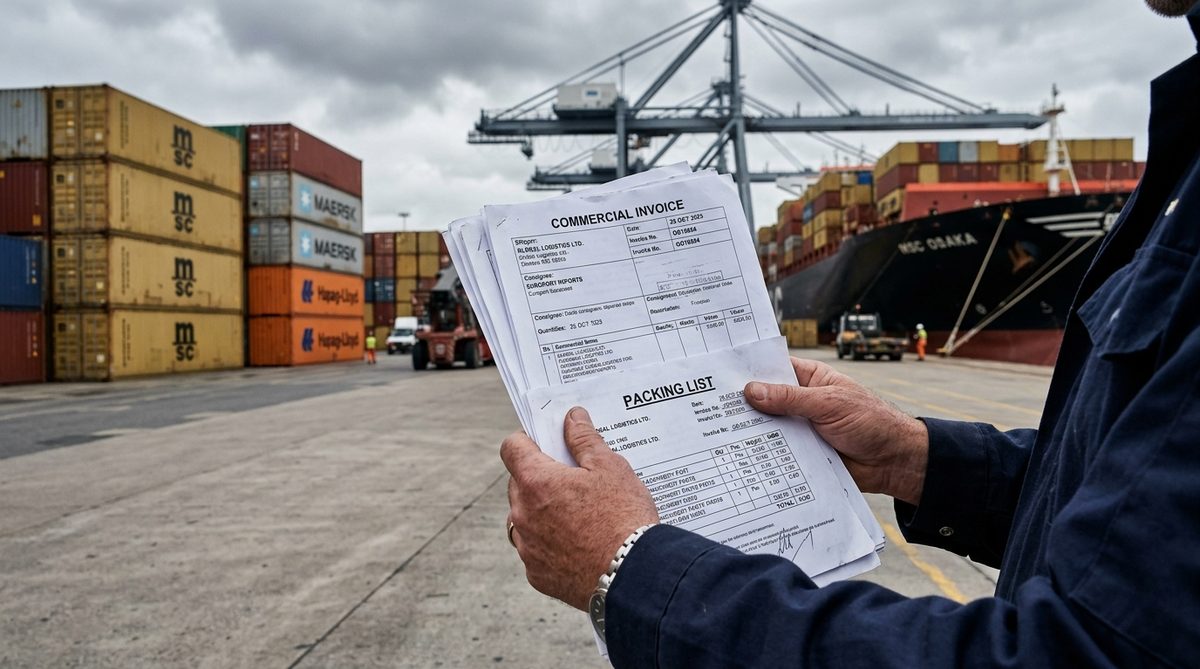
A container arrives at Rotterdam on a Tuesday. On Thursday your broker emails: customs has queried the declaration. On the following Monday you learn the query is about the commercial invoice description — “textile products” isn’t specific enough to confirm the classification. By the time the supplier sends a corrected invoice, the goods have been sitting for nine days, demurrage has started, and the customer who was expecting delivery this week is now expecting an explanation.
Nothing went wrong at the port. Everything went wrong six weeks earlier, when nobody checked what the supplier was going to write on the invoice.
This is what customs delays actually look like for small importers. Not seizures, not investigations, not smuggling — just a document that says the wrong thing, discovered at the worst possible moment, resolved on a timeline nobody controls. Almost all of it is preventable with checks that take minutes and happen before the goods ship.
What Actually Causes Delays
Documentation errors are the overwhelming majority.
Small importers imagine customs as an enforcement body looking for wrongdoing. Mostly it’s a data-processing operation, and a declaration is a data record that either validates or doesn’t. When it doesn’t, a human gets involved, and human involvement is where the days go.
The recurring causes, in rough order of frequency:
- Vague goods descriptions on the commercial invoice. “Machine parts,” “textile goods,” “electronic components,” “samples.” None of these support a classification. Customs cannot verify a tariff heading against a description that could mean forty different things.
- Mismatches between documents. The commercial invoice says 480 units, the packing list says 500, the bill of lading says 24 cartons and there are 25. Any inconsistency across the invoice, packing list, transport document, and declaration triggers a check. The system is looking for agreement, and it finds disagreement in a startling share of small shipments.
- Missing or invalid EORI. No EORI, no import. It’s a one-time registration through your national customs authority and it’s free — the Commission’s EORI validation tool confirms whether a number is live. Small importers discover they need one when the goods are already in transit more often than seems possible.
- Incorrect HS classification. Either wrong, or right but unsupportable from the documents provided.
- Origin claimed without proof. Preferential duty rates claimed on a shipment with no valid origin document. This one is expensive rather than just slow.
- Valuation queries. The declared value looks wrong relative to what customs expects for that product and origin.
- Missing product compliance documents. CE marking documentation, REACH, food or cosmetic certifications. Category-specific and unforgiving.
Notice what’s absent from this list: anything to do with the shipping line, the port, or the broker. The failure is nearly always in paperwork that originated with your supplier.
HS Classification — Getting It Right Before the Goods Move
The code drives everything downstream.
The Harmonised System code determines the duty rate, whether anti-dumping duties apply, whether you need licences, whether import restrictions bite, and whether preferential origin can be claimed. It is the single most consequential number on the declaration, and it’s routinely decided by whoever was filling in the form fastest.
- The first 6 digits are the international HS code, common worldwide.
- The EU extends this to 8 digits (Combined Nomenclature) and 10 digits (TARIC) for measures like anti-dumping duties and suspensions.
How to classify properly:
- Look it up yourself in TARIC, the Commission’s tariff database. It’s public, free, and gives duty rates and applicable measures per code and per country of origin. Twenty minutes with TARIC before you place an order tells you your landed duty cost, which you should know before you agree a price.
- Don’t let the supplier classify for you. They classify for export from their country, under their rules, with no consequences for getting it wrong in yours. A supplier-supplied HS code is a starting hypothesis, not an answer.
- Don’t let the broker guess. Brokers classify from the invoice description. If your description is vague, their classification is a guess made under time pressure, and you carry the liability for it, not them.
- For anything ambiguous or high-volume, get a Binding Tariff Information decision. A BTI is a formal ruling from a national customs authority, valid across the EU for three years. It takes weeks to obtain and it is free. If you’re importing the same product repeatedly, a BTI converts a recurring risk into a settled fact. Almost no small importers use them, and the ones who do stop having classification arguments entirely.
The description rule.
Write invoice descriptions that make the classification obvious without anyone needing to ask. Not “cotton shirts” but “men’s woven shirts, 100% cotton, HS 6205.20.” Material, function, form, and the code. This one habit removes the most common delay cause in small-importer shipments, and it costs one email to the supplier before they issue the invoice.
Make it a condition of the order, not a request afterwards. That’s a negotiation point, and it belongs in the same conversation as price and terms — see the guide to supplier negotiation for small importers for when to raise it.
Origin and Valuation — The Two Expensive Ones
Origin is not where it shipped from.
Origin is where the goods were produced or last substantially transformed. A shipment leaving a Turkish warehouse full of Chinese-made goods has Chinese origin, and claiming otherwise is not an administrative slip.
Two distinct concepts, constantly conflated:
- Non-preferential origin — determines whether anti-dumping duties, quotas, or trade measures apply. Always relevant.
- Preferential origin — determines whether a reduced or zero duty rate under a trade agreement applies. Only claimable with valid proof.
Preferential origin requires documentation: a movement certificate, an origin declaration on the invoice from a registered exporter, or a statement on origin, depending on the agreement. The document must be valid at import, issued by an entitled party, and consistent with the goods.
The failure mode is specific and it is costly: you claim preference, customs later reviews, the proof is defective, and you owe the full duty plus interest on shipments that cleared months ago. This does not delay a container — it arrives as a demand years later, after you’ve sold the goods at a margin calculated on a duty rate you weren’t entitled to. Do not claim preference unless you have the document in hand and have read it.
Valuation queries.
The customs value is normally the transaction value — what you actually paid — plus freight and insurance to the EU border, plus certain additions like royalties and assists. Queries come when:
- The declared value is well below what customs expects for that product and origin. Their reference data is better than most importers assume.
- Related-party pricing, where the buyer and seller are connected.
- Freight costs are excluded when the Incoterm means they should be included, or included when they shouldn’t. This is a direct consequence of getting the Incoterm wrong on the declaration, which is common — the transfer points are covered in the Incoterms guide for B2B trade.
- The invoice currency and the declared value don’t reconcile at the applicable exchange rate. Customs uses a set monthly rate, not the spot rate on your bank statement, which surprises people. Where currency movement is material to your landed cost, the mechanics in FX risk for B2B importers apply here too.
A valuation query is answerable with proof of payment and a clear invoice. It’s slow, not fatal — unless you can’t produce the proof, in which case customs values the goods themselves and you accept their number.
The Pre-Shipment Checklist
This is the part that prevents nearly all of it. Ten minutes per shipment, before the goods leave.
Before you place the order:
- HS code confirmed in TARIC, duty rate known, any anti-dumping measures checked against the actual country of origin
- EORI number valid and on file
- Origin established and the proof document confirmed as obtainable — not assumed
- Product compliance requirements identified for the category
- Incoterm agreed and understood by both sides
Before the goods ship — request and review the draft documents:
- Commercial invoice: full legal names and addresses of both parties, your EORI, invoice number and date, specific goods description with HS code, quantity, unit price, total, currency, Incoterm and named place, country of origin, payment terms
- Packing list: matches the invoice on every quantity, carton count, and weight
- Transport document: consignee details correct, matches the rest
- Origin proof: present, valid, correctly completed
- Any category-specific certificates
Review the drafts, not the finals. A supplier who has already issued a signed original will resist reissuing it, and the reissue costs days. Ask for drafts as a standing condition on every order and check them the day they arrive.
The consistency check.
Lay the invoice, packing list, and transport document side by side. Every number that appears in more than one place must be identical. Quantity, weight, carton count, value, party names. This takes three minutes and catches the most common delay trigger in small-importer shipments.
Know your broker’s actual role.
Your broker submits what you give them. Under direct representation they act in your name and the liability is yours. Under indirect representation they act in their own name and share it — which is why brokers avoid it. Either way, “the broker handles customs” is not a control. They handle submission. You handle correctness. The Commission’s customs pages set out the procedural framework if you want the underlying rules rather than your broker’s summary of them.
The uncomfortable truth about customs delays is that they’re almost never a customs problem. They’re a supplier-documentation problem that surfaces at customs, weeks after the point where it was cheap to fix, at a location where every day has a price attached.
The importers who don’t have this problem aren’t luckier or better connected. They classified the product before ordering, they told the supplier exactly what to write on the invoice, and they read the drafts. That’s the entire method. It takes ten minutes a shipment and it replaces a recurring category of expensive surprise with a routine that no longer generates any stories worth telling.
Sources: European Commission — Customs · TARIC consultation database · EORI number validation