
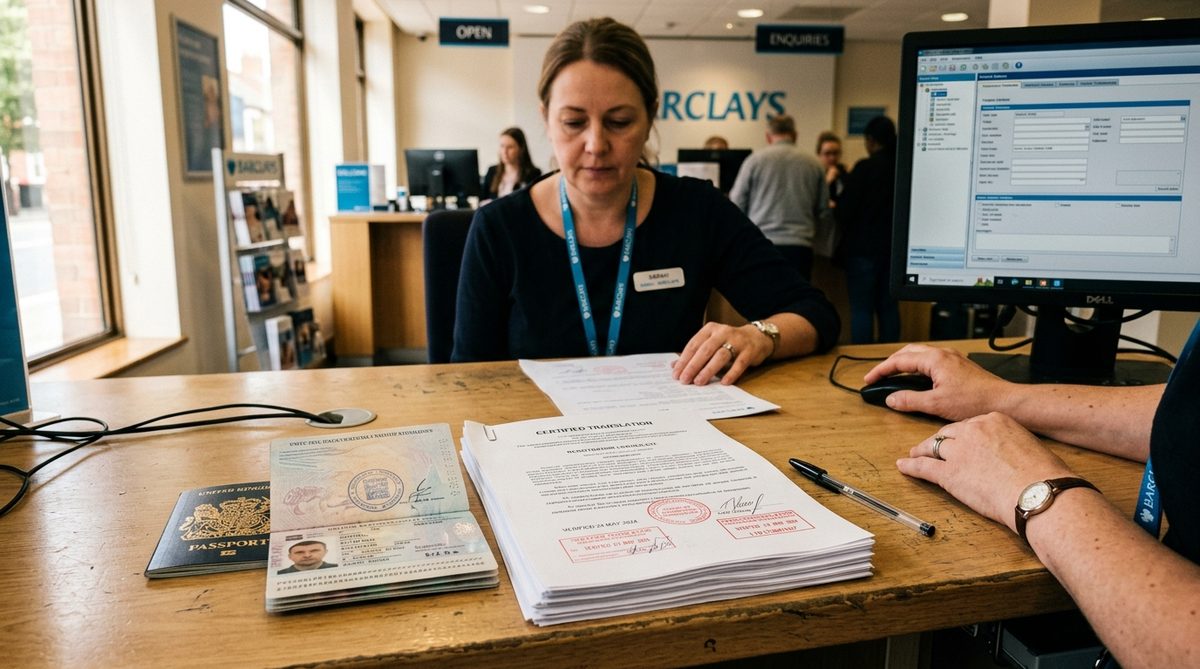
The company registration in Serbia took five working days and cost a few hundred euros. Everyone tells you this, and it’s true. What nobody tells you is that the bank account — the thing that makes the company a business rather than a certificate — can take four weeks, get declined twice for reasons nobody will explain, and depend heavily on which branch you walk into.
This is not a Serbian peculiarity. It’s what happens everywhere when a foreign founder with no local history asks a bank to take on an account whose compliance profile the bank cannot cheaply assess. Serbia is outside the EU, outside the euro area, and sits on trade routes that make correspondent banks pay attention. Your account application is a risk decision, and the person making it has no upside if they’re right and a career problem if they’re wrong.
Understanding that reframes the whole exercise. You are not filling in a form. You are making it easy for a compliance officer to say yes. This guide covers how.
Resident vs Non-Resident — The Distinction That Governs Everything
The two things people mean by “banking in Serbia.”
- A resident company account. You register a Serbian legal entity — usually a d.o.o., the limited liability company — through the Business Registers Agency, and that company opens an account as a Serbian resident. The company is resident; you as the owner can live anywhere.
- A non-resident account. A foreign person or foreign company holds an account at a Serbian bank without a Serbian entity. This is permitted and it is more restricted in what it can do, particularly in dinar transactions.
For almost every operating business, the first is what you want. A non-resident account is for holding funds, receiving specific payments, or property transactions. Trying to run a trading business through one produces constant friction with the foreign exchange rules.
So in practice, banking follows incorporation. If you haven’t formed the entity yet, that decision comes first and shapes everything downstream — the guide to Serbian company setup for a non-EU founder covers the entity side.
The sequencing trap.
The order is: register the company at APR, get the registration decision and company registration number, then open the account. But you’ll be asked to deposit share capital, and the statutory minimum for a d.o.o. is famously trivial — 100 dinars, well under a euro. Do not deposit the minimum.
A company with under one euro of capital applying for a bank account is a compliance officer’s least favourite document of the week. It looks like a shell because it is structurally indistinguishable from one. Capitalise the company with something proportionate to what it will actually do — a few thousand euros for a small consultancy — and the conversation changes tone immediately. This costs you nothing; it’s your own money in your own company.
The Documents — And Why Half of Them Get Rejected
The standard pack for a resident company account:
- APR registration decision (rešenje o registraciji)
- Company registration number and tax identification number (PIB)
- Founding act / articles of association
- OP form — certified signatures of persons authorised to represent the company
- Passports of all directors and authorised signatories
- Proof of address for the same
- Ultimate beneficial owner documentation — the one that causes the most trouble
- Company stamp, if you have one (no longer legally required, still requested by some branches)
Where foreign documents fail.
Any document issued outside Serbia needs to survive two steps, and both get skipped by people who assume a document is a document:
- Apostille, under the Hague Convention, from the issuing country. Serbia is a party, so an apostille is sufficient for most countries and no full consular legalisation is needed. For countries outside the convention, it’s the longer route.
- Translation by a court-certified translator (sudski tumač). Not any translator. Not a good one you know. A court-appointed one, whose stamp the bank recognises. Budget roughly €15–30 per page and two to three days.
Both steps have a shelf life in practice — banks routinely want documents issued within the last three to six months. An apostilled certificate of incorporation from 2019 will be refused, politely, at the counter, after you’ve paid to translate it.
UBO documentation is where non-EU founders actually get stuck.
The bank must identify every natural person ultimately owning or controlling the company, usually above a 25% threshold. If your ownership runs through another company, they need to see through it — corporate documents for the parent, apostilled and translated, and so on up the chain until they reach humans.
The practical consequences:
- A single layer of ownership clears far faster than two. If you can own the Serbian entity directly as a natural person, do. A structure with a holding company in a third jurisdiction may be entirely legitimate and will still add weeks and may end in a decline the bank won’t explain.
- Have the chain documented before you apply. Discovering mid-application that you need an apostilled shareholder register from another country adds a month.
The KYC Conversation — What They’re Actually Asking
The account opening interview looks like a formality and isn’t. The questions are risk assessment, and vague answers are the most common cause of a decline.
What they will ask, and what a good answer looks like:
- “What will the company do?” — Not “consulting.” Say: “Business process consulting for European small manufacturers, three to five clients a year, projects of €10,000 to €40,000, invoiced monthly.”
- “Where will the money come from?” — Named countries, named client types. “Payments from EU-registered companies, mainly Germany and Austria.”
- “Where will it go?” — Salaries, supplier payments, dividends, named jurisdictions.
- “Expected monthly turnover?” — Give a number. A founder who can’t estimate their own revenue is a founder who hasn’t thought about the business or isn’t describing it accurately, and both readings are bad.
- “Why Serbia?” — Have a real answer. “Lower cost of operation, I’m resident here, my clients are in the EU” is real. Anything that sounds like tax structuring will be heard as tax structuring.
Countries and connections change the temperature.
Serbian banks maintain correspondent relationships with EU and US banks, and those correspondents impose their own expectations. Anything touching sanctioned jurisdictions triggers enhanced due diligence at minimum. This is not a Serbian policy — it’s the correspondent’s, applied through the Serbian bank, and no branch manager can override it.
If your business has connections to a country that draws attention, the honest strategy is to say so upfront, in writing, with the compliance context you’ve already worked out. Founders instinctively downplay it and get declined for non-disclosure rather than for the underlying fact. A bank that declines you at application costs you three weeks. A bank that discovers something unexpected in month eight closes your account with thirty days’ notice and no appeal, which is a different order of problem.
Expect it to take longer than anyone tells you. A clean application from an EU founder with straightforward ownership: one to two weeks. A non-EU founder with a multi-layer structure: four to eight weeks, with rounds of additional requests. Assume the long end and don’t sign anything that assumes the short end.
Currency, Payments, and Daily Operation
The dinar rules are stricter than EU founders expect.
Serbia’s currency is the dinar (RSD). The National Bank of Serbia runs a managed float and has held EUR/RSD in a notably narrow band for years, around the high 110s — which is unusual for a non-euro currency in the region and makes euro-denominated planning far more predictable than the label “emerging market currency” would suggest. It is a policy outcome, not a peg, and policy can change.
What the foreign exchange rules mean in practice:
- Domestic transactions between Serbian residents must generally be in dinars. You cannot invoice a Serbian company in euros and expect to be paid in euros. This surprises founders who assumed euro accounts make the currency question go away.
- You can hold foreign currency accounts alongside your dinar account. Most operating companies run both.
- Cross-border payments require documentation — the bank will ask for the invoice or contract supporting an incoming or outgoing international payment. This is a foreign exchange reporting requirement, not the bank being difficult, and it means your paperwork needs to exist at the moment of payment rather than at year-end.
- Conversion happens at the bank’s rate, which is not the NBS middle rate. The spread is where banks make money on foreign-owned companies. Ask for the actual spread on EUR/RSD conversion before choosing a bank; it varies meaningfully and it will be a recurring cost for the life of the company.
The NBS publishes rates and the regulatory framework on its official site, and for euro-side planning the ECB reference rates are the standard benchmark. If a meaningful share of your costs and revenues sit in different currencies, the exposure is real even with a stable band, and the mechanics in FX risk for B2B importers apply directly.
On international transfers. Payments in and out of Serbia have traditionally been handled as international wires with correspondent banking, with the fees and timelines that implies. Serbia’s integration with European payment infrastructure has been moving, and what your specific bank supports today is worth confirming with them directly rather than taking from any article, including this one. Ask the question plainly at account opening: what does a payment from a German client cost me, and how long does it take? Get the answer before you choose.
One thing to sort out early: if you sell digital services or products to customers elsewhere in the EU, your Serbian entity has no EU establishment, and the VAT treatment is not the one an EU-based competitor faces. That’s a separate regime with its own registration path — see the EU VAT One Stop Shop guide for what applies to a non-EU seller.
Choosing a Bank
The realistic landscape.
The Serbian market is dominated by subsidiaries of larger European groups — Banca Intesa, OTP, Raiffeisen, UniCredit, NLB, Erste — alongside domestic institutions such as AIK Banka. The NBS maintains the register of licensed banks, which is the only authoritative list and worth checking rather than relying on a blog’s.
What actually differentiates them for a foreign-owned small company:
- Appetite for non-resident-owned entities. This varies by bank, by year, and honestly by branch. It is not published. The only way to find out is to ask.
- English-language service. Uneven. Some banks have genuinely fluent business banking teams; others will hand you a Serbian-only contract and a form to sign.
- FX spread on EUR/RSD. Ask for the number.
- Online banking that works from abroad. Several still use SMS-based authentication to a Serbian number, or a physical token you must collect in person. If you don’t live in Serbia, ask this before you apply, not after.
- Monthly account maintenance fees. Typically a modest but non-trivial monthly charge, plus per-transaction fees on international payments.
Two practical tactics that work.
First, apply to two banks in parallel. Applications are free, declines are unexplained, and the cost of a single rejection is weeks. Redundancy is cheap here.
Second, go through an accountant with a relationship. A local accountant who brings the bank a properly assembled application and vouches informally for the client is not a formality — it materially changes both the timeline and the outcome. You will need a Serbian accountant anyway; local bookkeeping and tax filing are not optional and not something to run remotely from a spreadsheet. Engaging one before the bank application, rather than after, is the single highest-return sequencing decision in the whole process.
The version of this that goes badly is the one where the founder treats banking as an administrative step after the real work of incorporation. They register with 100 dinars of capital, arrive at a branch with an untranslated passport scan and a description of the business as “international trading,” get declined, and conclude that Serbian banks are hostile to foreigners.
The version that goes well takes the compliance officer’s side of the desk seriously. Capitalise properly. Get the documents apostilled and court-translated before you fly. Write down a specific, honest description of the business — what it does, who pays, from where, roughly how much. Disclose anything awkward yourself, first. Apply to two banks through an accountant who knows them.
Do that and the account takes two weeks and the story is boring. Boring is the goal. In banking, being interesting is the thing you’re trying to avoid.
Sources: National Bank of Serbia · NBS register of licensed banks · Serbian Business Registers Agency · ECB euro reference exchange rates