
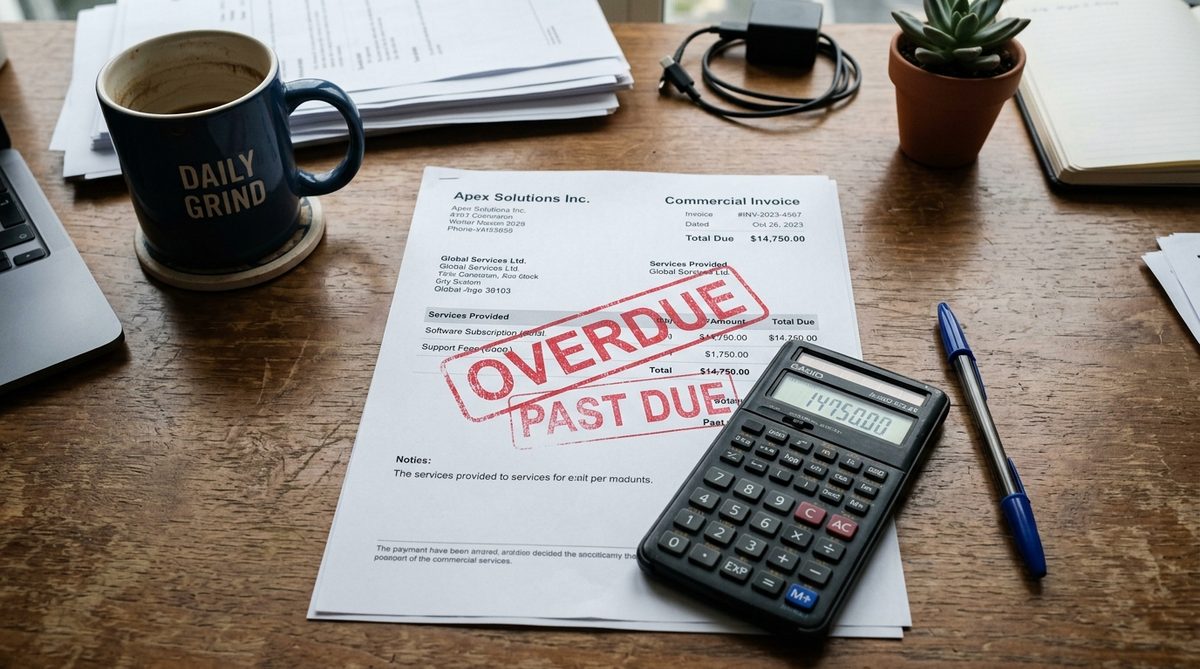
There is a particular kind of company that fails while profitable. The P&L looks fine, the order book is growing, margins are holding — and there is no money in the account on the 28th. This is not an accounting curiosity. It is the most common way a growing B2B business dies, and the mechanism is almost always the same: the company pays its suppliers faster than its customers pay it, and growth widens the gap rather than closing it.
Payment terms are where this gets decided, and they are treated with astonishing casualness in most small companies. Someone put “net 30” on the invoice template in 2019. A large customer asked for 60 and got it, because saying no felt risky. A supplier moved to prepayment and nobody renegotiated. Nobody has ever calculated what any of it costs.
This is the finance side of B2B operations, written for the person who owns the company rather than the person who owns the ledger: how the cash conversion cycle actually works, what European late-payment law entitles you to and why almost nobody uses it, how to price terms as a commercial variable, and the collections process that gets invoices paid without damaging relationships.
The Cash Conversion Cycle — The Number That Explains the 28th
Three numbers, one answer.
The cash conversion cycle (CCC) tells you how many days your money is tied up between paying for something and getting paid for it. It has three components:
- DSO — Days Sales Outstanding. Average days from invoicing a customer to receiving their money.
- DIO — Days Inventory Outstanding. Average days stock sits before it is sold. Zero for a pure services firm.
- DPO — Days Payable Outstanding. Average days from receiving a supplier invoice to paying it.
CCC = DSO + DIO − DPO.
A distributor with DSO of 52, DIO of 45 and DPO of 30 has a CCC of 67 days. That means every euro of sales requires funding for 67 days before it comes back. Grow revenue 40% and your working capital requirement grows roughly 40% too — which is why fast growth and insolvency are close neighbours.
Calculate yours before reading further.
- DSO = (accounts receivable ÷ revenue) × days in period
- DIO = (average inventory ÷ cost of goods sold) × days in period
- DPO = (accounts payable ÷ cost of goods sold) × days in period
Use the last twelve months. It is fifteen minutes of work in a spreadsheet with three numbers off your balance sheet and two off your P&L. Most owners have never done it, and the number is usually 15–25 days worse than they guessed — because agreed terms and actual behaviour are different things.
Agreed terms are fiction; DSO is fact.
This is the point worth pinning to the wall. Your invoice says 30 days. Your DSO says 52. That 22-day gap is the real state of your business, and it exists because payment terms without a collections process are a suggestion. Nobody is being malicious. Your invoice sits in a queue behind the invoices of suppliers who chase.
What a day is worth.
For a company doing €1.2m a year, one day of DSO is roughly €3,300 of cash. Cutting DSO from 52 to 38 releases about €46,000 — permanently, without a single additional sale, and at a cost of some emails. Compare that to the effort required to win €46,000 of new revenue at, say, 20% margin. This is why collections is a commercial activity, not an admin one.
What EU Late Payment Law Actually Gives You
The rules exist and they are stronger than most owners think.
Directive 2011/7/EU on combating late payment in commercial transactions sets the framework across the EU, transposed into each member state’s national law. The core provisions for B2B:
- The default payment period is 30 days from receipt of invoice or of the goods/services, where no period is fixed in the contract.
- Contractually agreed periods should not exceed 60 days, unless expressly agreed and not grossly unfair to the creditor.
- Statutory interest on late payment runs at the ECB reference rate plus at least eight percentage points, and it accrues automatically — no reminder required, no agreement required.
- A fixed minimum of €40 is recoverable as compensation for recovery costs, per invoice, plus reasonable additional recovery costs above that.
The applicable ECB rate is published on the ECB’s website alongside its other reference rates. Public authorities are held to 30 days, with narrow exceptions.
Why nobody uses it.
Because invoicing a customer for €40 plus interest feels like starting a fight over small money. That instinct is right about the invoice and wrong about the entitlement. The value of the law is not in collecting the €40. It is in the sentence you get to write:
“Our terms are 30 days net. Under the applicable late payment legislation, invoices unpaid after that date accrue statutory interest at the ECB reference rate plus 8 percentage points, together with the statutory recovery compensation. We would rather not apply it.”
That sentence, in the second reminder, moves your invoice up the payables queue — not because of the amount, but because it signals that you are a supplier who tracks. Accounts payable departments are rational; they pay the people who notice.
Put it in the terms, in advance.
Late payment interest referenced in your standard terms and conditions, on your quote, and in the invoice footer costs nothing and changes the default. A customer who reads it at quotation stage has already been told. A customer who first hears it in reminder three thinks you invented it.
Terms as a Commercial Variable — Stop Giving Them Away
Payment terms have a price. Charge it, or trade it.
Extending a customer from 30 days to 60 is not a goodwill gesture. It is a loan. If your cost of capital is 10% annually, 30 extra days on a €200,000 annual account costs you roughly €1,600 a year — quietly, out of margin, with nothing received in return.
Once you see terms as a priced product, three moves open up.
1. Trade terms for something.
Never extend terms for free. Extend them in exchange for volume commitment, a longer contract, a price increase, or a payment guarantee. “We can do 60 days at a 2% higher unit price, or 30 days at the current price — your choice” is a normal, professional conversation that most small suppliers never have. Roughly half the time the buyer takes 30 days, because their own procurement is measured on price, not on DPO.
2. Early payment discount, priced correctly.
The classic “2/10 net 30” — 2% off if paid within 10 days, otherwise the full amount at 30 — sounds generous and is expensive. You are giving 2% to accelerate payment by 20 days, which annualises to roughly 37%. Only offer it if your alternative funding costs more, or if the customer is a genuine payment risk and 98% now beats 100% maybe. Do not offer it as a habit. Most companies that offer 2/10 have never annualised it.
3. Deposits and staged payments.
For project and service work, this is the single most effective structural fix and it is under-used out of squeamishness. 30% on signature, 40% at milestone, 30% on completion turns a 60-day collection problem into a rolling cash-positive position. Customers accept it far more readily than suppliers expect — it is standard in construction, professional services and capital equipment, and B2B buyers are used to it. Ask.
Segment your terms.
Uniform terms for all customers is a comfortable policy and an expensive one. Tier them:
- New customers, no history: prepayment or 50% deposit for the first two orders. No exceptions, regardless of how the conversation feels.
- Established, clean payment history: standard terms, whatever you have set.
- Strategic accounts with volume: negotiated terms, explicitly priced into the deal.
- Slow payers on record: terms tightened at renewal, stated plainly and unemotionally.
Cross-border adds a layer. For customers outside the EU your legal recourse is materially weaker and slower, so the commercial structure has to carry the risk instead — letters of credit, advance payment, or credit insurance. The delivery-term choice interacts directly with this: who bears risk and cost at which point is an Incoterms question, and getting it wrong changes when you are entitled to be paid at all. The mechanics are covered in Incoterms for B2B trade between the EU and Iran, and where the invoice is denominated in a currency you do not hold, the exposure compounds — see FX risk for B2B importers.
The Collections Process That Actually Works
Most invoices are late because nobody asked.
Before assuming bad faith, understand the mechanics. In a mid-sized company the invoice arrives at a shared mailbox, needs coding, needs approval from the person who ordered, and joins a payment run that happens on fixed dates. Any missing PO number, wrong entity name or unclear reference silently parks it. The buyer does not know. Your invoice is not refused; it is stuck.
So the first fix is not chasing. It is invoice hygiene:
- Correct legal entity name and address, exactly as registered
- The PO number, if they use POs — and ask at order stage whether they do
- The named contact who approved the purchase, on the invoice
- Sent to the accounts payable address, not to your sales contact’s inbox
- Sent the same day as delivery, not at month end
Invoicing at month end, in a batch, is a self-inflicted DSO problem: an invoice for a 2 September delivery sent on 30 September has already burned 28 days of its own terms.
The ladder.
Automate the first three rungs. A human should only appear at rung four.
- Day minus 5 (before due): A short, friendly note. “Invoice 2041 falls due on the 14th — anything you need from us?” This single message catches the stuck-invoice problem while there is still time, and it is the highest-yield contact in the whole ladder.
- Day plus 1: Automated reminder, invoice attached again. Neutral tone.
- Day plus 7: Second reminder, referencing your terms and the statutory interest provision. Still neutral.
- Day plus 14: A phone call. Not an email. Ask one question: “Is there a problem with the invoice, or is it a timing issue?” The answer tells you which of two entirely different situations you are in.
- Day plus 30: Formal notice, interest and recovery compensation applied, further supply on hold pending payment.
- Day plus 60: Escalate — collections agency or legal, depending on amount.
Stop supply. It is the only real lever.
Everything before “we will not ship the next order” is a request. That is the point at which an unpaid invoice becomes the buyer’s problem instead of yours. Small suppliers avoid it because they fear losing the account — but an account that only exists because you finance it at 90 days is not an asset. Run the number: what does that customer contribute in margin, and what does their DSO cost you in funding? Sometimes the honest answer is that your worst payer is your worst customer.
Make it someone’s job, with a number.
Collections without an owner does not happen. One named person, thirty minutes every Tuesday, working an aged debtors list. The metric is DSO, reviewed monthly on the same page as revenue. Anything ageing past 60 days gets discussed by name.
Instrument it.
None of this survives on memory. The due date, the reminder ladder, the payment history per customer and the escalation state need to live in a system that prompts rather than a person who remembers — the same discipline as any other recurring commercial process. Whether that is your accounting package or the customer record itself, it belongs next to the rest of the account data rather than in someone’s head. And where revenue is contractual and recurring rather than order-by-order, much of this problem simply dissolves — the cash arrives before the work, which is one of the quieter arguments in favour of recurring revenue models for distributors.
None of this is sophisticated finance. It is a fifteen-minute calculation, a paragraph in your terms, a five-rung reminder ladder, and the willingness to treat payment terms as something you sell rather than something you concede. The reason it goes undone is that every individual step feels slightly awkward and none of them feel urgent — until the 28th. A company that cuts DSO by two weeks has effectively raised an interest-free facility from its own customers, without a bank, without dilution, and without selling anything new. That is usually the cheapest money available to a small B2B business, and it is sitting in the accounts receivable ledger right now.
Sources: Directive 2011/7/EU on late payment in commercial transactions, EUR-Lex · European Central Bank — reference rates