
A manufacturer in Iran, Turkey, Serbia or Vietnam quotes a German buyer. The product is genuinely equivalent to the German incumbent’s. The price is 30% lower. The specification sheet matches. The buyer says they will come back, and does not.
The reflexive explanation is prejudice, and there is some of that. But the more accurate and more useful explanation is that the buyer was doing arithmetic, not discrimination. A procurement manager who switches to an unknown supplier from an unfamiliar jurisdiction and saves 30% gets a modest note in their annual review. The same manager, if a delivery fails and a production line stops, gets a very different conversation. The saving accrues to the company. The risk accrues to the individual. Faced with that asymmetry, the rational move is to not respond to your email.
This means country-of-origin bias is not primarily a sentiment problem, and it will not yield to better adjectives. It is a perceived-risk problem, and perceived risk yields to evidence, structure and guarantees. That is a solvable engineering problem rather than a branding one — which is good news, because it means the fix is available to a small exporter with no marketing budget.
Diagnose the Actual Objection Before Answering It
Four different fears wearing the same clothes.
“We prefer to work with established European suppliers” is not one objection. It is at least four, and they need entirely different answers. If you respond to the wrong one you will feel like you are being stonewalled.
- Quality risk. “Will it meet spec, consistently, on the ten-thousandth unit and not just the sample?”
- Continuity risk. “Will you still exist and still ship in eighteen months? What happens if there is a sanctions change, a currency crisis, a political event?”
- Logistics and administrative risk. “Who handles customs? What is the real lead time including the border? Who is liable if it sits in a port for three weeks?”
- Recourse risk. “If this goes wrong, what can I actually do about it? Which court? Which language? What does that cost me?”
The last one is the quietest and the largest. A German buyer knows precisely what happens if a German supplier breaches — a known process, in their language, with a predictable cost. Against a supplier in an unfamiliar jurisdiction, they do not know, and unknown recourse is priced as infinite risk.
Find out which one it is.
Ask directly, in the follow-up: “If we set price aside entirely — assume we matched the incumbent — what would still make this difficult to approve internally?” Most buyers will answer that question honestly, because it costs them nothing and it is not a negotiation. The answer tells you which of the four you are actually fighting. Nearly every exporter answers all four generically and lands on none of them.
Build the Proof Structure, Not the Story
Certification is the entry ticket, not the pitch.
Third-party certification does one specific job: it converts “trust us” into “trust them.” A buyer does not have to believe your quality claims if an accredited body has already tested them. Depending on your product, the relevant set is some combination of:
- ISO 9001 for quality management — the baseline procurement expectation. ISO publishes the standards; certification comes from an accredited body, not from ISO itself.
- Product-specific conformity requirements for the EU market — CE marking where the product falls under a relevant directive, and the technical documentation behind it. The EU’s Access2Markets portal sets out the requirements, duties and rules of origin per product and country of origin, and it is the single most useful free resource an exporter into the EU has.
- Sector standards where they exist — the ones your buyer’s own customers ask them about.
- Test reports from a European laboratory. Frequently more persuasive than a certificate from a domestic body, for a plain reason: the buyer has heard of the lab.
None of this is marketing. It is removing reasons to say no.
Evidence beats adjectives, in a specific ratio.
Compare two claims about the same factory:
“We are committed to the highest quality standards and customer satisfaction.”
“ISO 9001 certified since 2019, audited annually by TÜV. Batch traceability on every shipment. Our defect rate over the last 24 months is 0.4%, and here is the report. Our largest customer, a Bavarian tier-2 automotive supplier, has been buying monthly since 2021 — you may call them.”
The first says nothing and is written by every supplier on earth. The second is falsifiable, which is exactly what makes it credible. The discipline to adopt: every claim on your site must be checkable, or deleted. An emerging-market exporter has a smaller trust budget than an incumbent, so every unfalsifiable adjective spends credibility rather than building it.
The reference customer is the strongest asset you own.
One European customer willing to take a phone call is worth more than your entire website. It resolves all four fears simultaneously and it does so from a source the buyer trusts more than you. Get one, whatever it takes — first order at cost if necessary, extended terms, an unusual guarantee. That first European logo, with a name and a phone number behind it, is the asset that makes the second and tenth possible. Price it accordingly.
Show the operation.
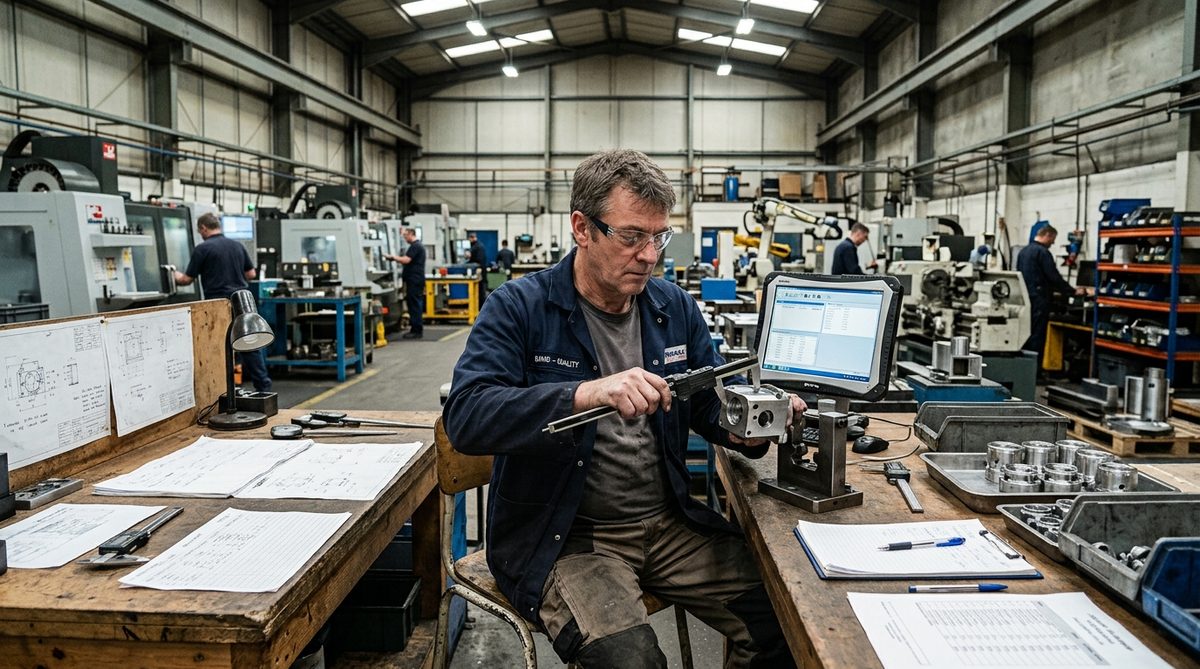
Photographs of the actual factory, the actual QC bench, the actual loading bay, with people in them. Not stock imagery. A short walkthrough video shot on a phone outperforms a professionally produced brand film, because the phone video is evidently real and the brand film is evidently paid for. Buyers evaluating an unfamiliar supplier are asking a very concrete question — does this place exist and does it look like it does this work — and a real photo answers it in two seconds.
Decide What You Say About Where You Are From
Three honest strategies. Pick one deliberately.
Exporters agonise over this and usually end up in the worst position by default: not lying, but not saying, and hoping. That reads as concealment the moment it surfaces — and it always surfaces, at the point in the process where it does the most damage.
Strategy 1 — Lead with origin.
Works when your country has a genuine, recognised reputation in your specific category. Turkish textiles. Serbian software engineering. Iranian saffron, pistachios, handmade carpets and certain petrochemical derivatives. Here, origin is a positive signal and hiding it discards an advantage.
Strategy 2 — Neutral origin, lead with proof.
The default for most industrial and component exports, where the country has no particular reputation in the category — neither good nor bad, just unfamiliar. Origin is stated factually where it belongs (in the specification, in the documentation, in the compliance data) and is not a theme of your positioning. Nothing is concealed; nothing is emphasised. The pitch is the evidence stack above.
Strategy 3 — European presence as the interface.
A registered entity in an EU or EU-adjacent country, a European bank account, EU invoicing, a European phone number, and stock held in Europe. This does not hide origin — the origin is on the customs declaration and the buyer will see it. What it does is remove three of the four fears at once: recourse becomes an EU-law question in a familiar court, payment becomes a normal domestic transfer, and logistics stop being the buyer’s problem because you have already imported.
This is the most expensive option and by far the most effective. It also reframes the negotiation: you are no longer an exporter asking a German firm to take a risk on Iran. You are a European supplier who happens to manufacture abroad — which describes most of European industry.
Never do the fourth thing.
Do not obscure. A vaguely European-sounding name, a stock photo of a skyline that is not yours, an address that is a mail-forwarding service. It fails, always, and it fails at the worst possible moment: the buyer discovers it during due diligence, after they have invested internal credibility in you. What they learn is not that you are foreign — they knew that. What they learn is that you conceal things. That is unrecoverable, and it is the one objection you can never answer.
Price, Guarantee, and the Discount Trap
Do not lead with 30% cheaper.
Every emerging-market exporter’s first instinct, and it is close to self-defeating. A deep discount from an unknown supplier is not read as value. It is read as confirmation — cheap because there is something wrong with it. It also validates the buyer’s private assumption that your only argument is price, which permanently caps what you can charge and makes you trivially replaceable by whoever is cheaper next year.
Price at a defensible discount and spend the rest on risk removal.
Price 10–15% below the incumbent — enough to matter, small enough to be attributed to your genuinely lower cost base rather than to a hidden defect. Then spend the other 15% on the things that dissolve the four fears:
- Stock held in Europe. Turns a six-week lead time with border uncertainty into a two-day delivery from a warehouse in Hamburg or Belgrade. This single move is worth more than the discount, because it converts you from an import project into a supplier.
- A first-order guarantee. Full replacement or full refund, no argument, on the first shipment. Your cost is your defect rate — which, if you are confident, is small. Their perceived saving is the entire downside of the decision.
- A paid pilot. A small order, at a real price, with a defined success criterion agreed in writing. Converts an irreversible-feeling decision into a reversible one, which is the psychological hurdle the whole process is stuck on.
- Terms that show confidence. Offering net 30 to a first-time customer signals that you expect to be around in thirty days. Demanding 100% prepayment signals the opposite, however reasonable your reasons.
Denominate and hedge deliberately.
Quoting in EUR when your costs sit in another currency is a decision with a real price attached, and quoting in USD to a European buyer imports a second currency’s volatility into a relationship that did not need it. The buyer is not absorbing that — you are, either in your margin or in the price you had to quote to protect it. The mechanics are in FX risk for B2B importers; the point for positioning is that a supplier who can hold a EUR price for a quarter looks structurally more stable than one who re-quotes every fortnight.
Get the delivery terms right the first time.
DDP quoting — you handle export, freight, import clearance and duty, and the goods appear at their door with a single price and no administrative work — is disproportionately persuasive to a buyer who is nervous about your jurisdiction, because it removes the entire category of logistics fear in one line of a quotation. It also costs you real money and exposes you to duties and clearance you may not fully understand, so it must be priced properly rather than offered as a gesture. Price it against the actual clearance and duty cost per shipment, not against a guess.
Be Findable in the Buyer’s Language and Format
The buyer researches you before they answer you.
Between your email and their reply, they search your company name. What they find decides whether there is a reply. If the search returns an unmaintained page, a Facebook profile from 2019, and nothing else, the four fears are all confirmed at once at zero cost to them.
The minimum credible footprint:
- A site that loads fast, states plainly what you make and for whom, and shows the factory
- Certifications, downloadable, as PDFs, not as logos
- Named people with real photographs — anonymity reads as risk
- A European address and phone number if you have one
- Specification sheets and technical documentation, downloadable without a form
That last point is worth arguing about internally. Gating your spec sheets behind a lead form, for an unknown supplier, is a mistake: an engineer who cannot get your data sheet uses the competitor whose data sheet they can get, and you never learn it happened. The broader conversion mechanics are in B2B website conversion.
In their language, properly.
A German industrial buyer will read English. But a German-language page tells them you take the market seriously enough to have made an investment in it, and it puts you in German-language search results where your incumbent competitor is unopposed. The tiering — where to spend on a professional translator and where machine translation is sufficient — is covered in AI translation for multilingual B2B content. The relevant point here: your terms, guarantees and compliance documentation belong in the professionally translated tier. Those are the exact documents that are read when trust is being decided.
The trust gap is real, it is quantifiable, and it is not permanent. It closes through certification the buyer’s own auditors recognise, evidence they can check without asking you, a reference they can phone, a legal structure that puts recourse in a court they understand, and stock close enough that a delivery date is a fact rather than a forecast. None of that is branding. It is the deliberate removal of every reason a procurement manager has to protect their own career by ignoring you. Do that work and the origin stops being the story — which, for most exporters, was always the goal.
Sources: ISO · European Commission — Access2Markets