
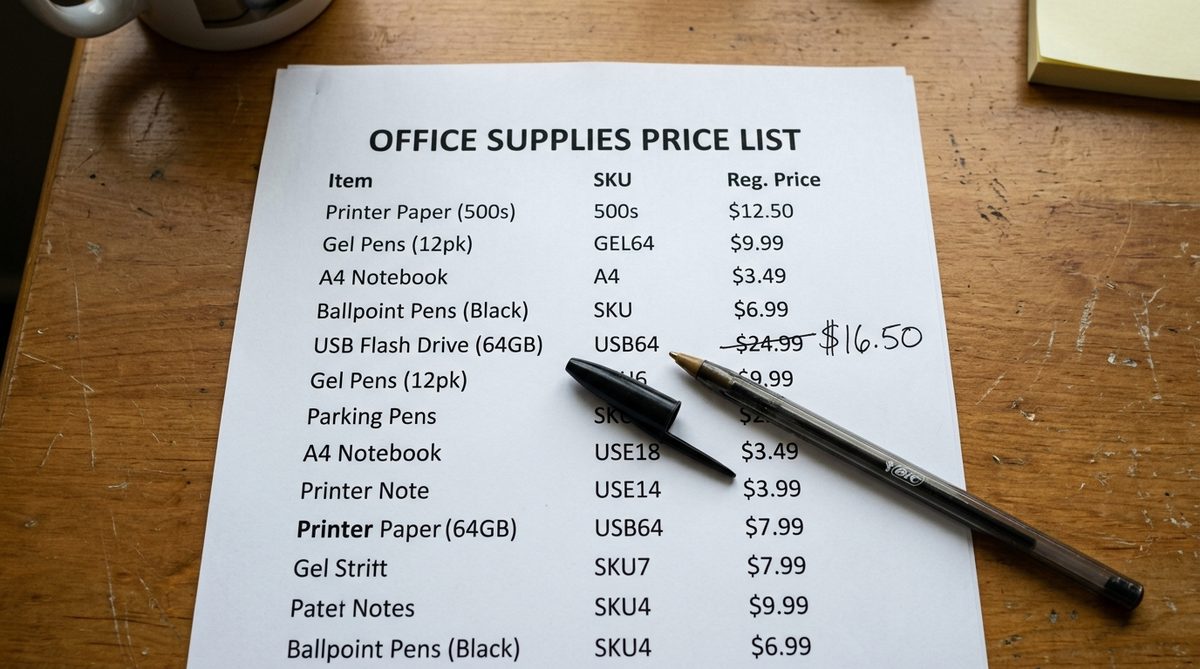
In most small B2B companies, the discount policy is a person’s mood. A salesperson is close to a deal, the buyer says the price is high, the salesperson takes 8% off, the deal closes, everyone is relieved. Nobody calculates what the 8% cost. Nobody records why it was given. Six months later that customer’s renewal starts from the discounted number, their neighbour in the same industry has heard about it, and the list price has quietly become fiction.
This is not a sales discipline problem. It is a design problem. If a salesperson has discretion, no guidance, and a commission tied to closing rather than to margin, discounting is the rational behaviour and you built the incentive yourself. The fix is not exhortation. It is a policy with tiers, triggers, trades and a paper trail — the whole thing fits on one page.
What follows is the arithmetic that makes the case, the structure of a policy that survives a real negotiation, the things worth trading for price, and the EU competition constraints that actually apply to a small distributor. It is the difference between a price list and a starting bid.
The Arithmetic Nobody Runs Before Saying Yes
A discount is not a percentage off price. It is a percentage off profit.
This is the single calculation that changes behaviour, and almost no salesperson has ever seen it.
Take a product at €100 with a 30% gross margin — so €70 of cost, €30 of profit. Give a 10% discount. The price is €90, the cost is still €70, the profit is €20.
You gave away 10% of the price and 33% of the profit.
At a 20% margin, that same 10% discount removes half the profit. At a 15% margin — normal in distribution — a 10% discount removes two thirds. The discount that felt like a rounding error in the meeting was a decision to work for a third of the money.
The volume required to break even is the number to put on the wall.
The follow-up question is always “but we got more volume.” Run it:
To earn the same gross profit after a discount, the extra volume needed is: discount ÷ (margin − discount).
At a 30% margin:
- A 5% discount needs 20% more volume to break even
- A 10% discount needs 50% more volume
- A 15% discount needs 100% more volume
At a 20% margin:
- A 5% discount needs 33% more volume
- A 10% discount needs 100% more volume
- A 15% discount needs 300% more volume
Print this as a small table, one row per margin band you actually sell at, and put it in front of anyone who can approve a discount. The conversation changes immediately — not because people become disciplined, but because “we’ll make it up on volume” becomes a testable claim instead of a feeling. Almost no volume commitment offered in a real negotiation clears these thresholds.
Know your margin per SKU before you write any policy.
You cannot set discount authority without knowing the margin the discount is eating. If your catalogue has SKUs at 45% and SKUs at 8% — and every distributor’s does — a single company-wide discount limit is guaranteed to be both too generous and too restrictive at the same time. Authority has to be set per margin band, which means the margin data has to exist per SKU first. If it does not, that is the actual project, and everything below waits.
Structure — Tiers, Triggers and the One-Page Policy
Someone will always ask. Decide in advance who can say yes.
Approval tiers are not bureaucracy. They are a device that lets a salesperson say “I can’t do that” and mean it, without it being personal and without it being a bluff. That sentence is worth real money and a salesperson cannot say it credibly unless it is true.
A workable structure for a small company:
- 0–5%: Salesperson’s discretion. No approval, but logged with a reason code.
- 5–10%: Sales manager approval. Written justification. Something must be traded (see below).
- 10–15%: Owner or commercial director. Requires a business case: the volume, the term, the strategic reason.
- Above 15%: Owner only, and the default answer is no. Reserve it for genuine strategic entries — a reference customer in a segment you are trying to open, priced as a marketing investment and recorded as one.
The logged reason code is the whole enforcement mechanism.
Every discount, including a 2% one, gets a code: VOLUME, TERM, COMPETITIVE, STRATEGIC, RELATIONSHIP. Thirty seconds in the CRM.
The value is not any individual entry. It is the quarterly report. When you sort a quarter of discounts by code and discover that 70% are coded RELATIONSHIP — which means “the customer asked and we felt bad” — you have found the leak, and you have found it with evidence rather than suspicion. This field belongs on the deal record alongside the rest of the commercial data; a minimum viable CRM with one dropdown does the job. A spreadsheet nobody fills in does not.
Structural discounts are fine. Situational ones are the problem.
Draw the line here and it clarifies everything:
- Structural discounts are published, rule-based, and available to anyone who meets the criteria: volume bands, annual commitment tiers, distributor versus end-user pricing, early settlement terms. These are pricing architecture. They are predictable, defensible, and they reward the behaviour you want.
- Situational discounts are given in a negotiation because someone asked. These are the leak.
A company with good structural discounts has fewer situational ones, because the buyer’s question — “what can you do on price?” — has a published answer: “at 500 units the price is X. You’re at 200. Get to 500 and you’re there.” That is a conversation about their behaviour rather than your goodwill.
Ban the round number.
A 10% discount sounds like a policy. A 7.4% discount sounds like a calculation. Buyers push harder against round numbers because round numbers signal that the figure was invented and can be re-invented. Deriving the number — from a volume band, a term, a specific trade — makes it defensible, and defensible numbers stop the second round of asking.
Never Give Price Away. Trade It.
Every discount buys something, or it does not happen.
This is the rule that does most of the work in practice. The buyer asks for 8%. The answer is never “no” and never “yes.” It is “for what?”
Things worth more than the discount, roughly in order:
- Volume commitment, contractual. Not “we’ll probably buy more.” A committed annual minimum with a clawback if missed. This is the only volume claim worth pricing.
- Term. A twelve-month or twenty-four-month agreement. Predictable revenue is worth real margin, and it is worth more than most owners charge for it.
- Payment terms. “We can do 6% if you go from 45 days to 14.” You just bought a month of working capital with margin you were going to lose anyway — and given what a day of DSO is actually worth, this is frequently the best trade on the list. The maths is in payment terms and cash flow in B2B.
- Range expansion. The discount applies if they add a second product line. You bought a wider account, which is much harder to displace than a single-SKU one.
- A case study, a reference call, or a logo. In a market where you are unknown, a named reference is worth more than 8% of one deal — sometimes far more.
- Forecast visibility. Committed rolling forecasts let you buy better and hold less stock. That is a real cost saving you can share.
- Order behaviour. Fewer, larger orders. Standard pallet quantities. Direct shipment instead of stocked. Every one of these lowers your cost to serve, and the last one changes the economics entirely — see dropshipping vs stockholding.
The removal alternative.
When there is genuinely nothing to trade, do not discount. Reduce the offer instead: fewer units, a shorter term, standard delivery instead of expedited, self-service instead of onboarding. “We can meet your budget at €X — that version doesn’t include the installation support” is a professional answer that holds your price integrity while still saying yes.
This matters beyond the deal. A price you reduce on request is a price you never had. Once a buyer learns that asking works, they will ask every time, forever, and so will everyone they talk to.
Discount the first order, not the relationship.
If you must buy entry, buy it once. A one-time onboarding discount, an introductory quantity, a pilot at a reduced rate with the standard price written into the same document from month four. What you must never do is discount the standing price, because that price is the base for every renewal, and it never comes back up. Concessions with an expiry date printed on them are recoverable. Concessions without one are permanent.
The EU Competition Rules That Actually Apply
You have wide freedom. There are three real limits.
Most small distributors either ignore competition law entirely or are vaguely terrified of it. The realistic position: as a company without market dominance, you can price differently for different customers, and doing so is normal commercial practice. But three constraints bind regardless of size.
1. You cannot fix your resellers’ prices.
If you sell through distributors or dealers, you may not dictate the price at which they resell. Resale price maintenance — setting a fixed or minimum resale price, or enforcing one through pressure or incentives — is a hardcore restriction under EU competition law and it does not benefit from the safe harbour. Recommended resale prices and maximum prices are generally permitted, provided they do not operate as fixed or minimum prices in practice. The framework is in Commission Regulation (EU) 2022/720, the vertical block exemption regulation, with its accompanying guidelines. The trap is the incentive that makes a “recommendation” effectively binding — a rebate withheld from a dealer who discounts is not a recommendation.
2. You cannot coordinate pricing with competitors.
Obvious in principle, casual in practice. Discussing prices, margins, discount levels or customer allocation with a competitor at a trade association meeting is a serious infringement, and “it was informal” is not a defence. Nor is listening without speaking. If it comes up, leave, and note that you left.
3. Discrimination rules bite if you are dominant.
Applying dissimilar conditions to equivalent transactions is an abuse under Article 102 — but only for undertakings in a dominant position. Most small distributors are nowhere near dominance in any properly defined market. If you have a very high share of a narrowly defined niche, this deserves a conversation with a lawyer rather than a blog post. The European Commission’s competition pages set out the framework.
The practical safeguard.
Structural, published, criteria-based discounts are the safest possible design and also the best commercial design. If your volume bands are written down and available to any customer who meets them, you are treating equivalent transactions equivalently by construction — and you have removed the situational discounting problem at the same time. Good policy and good compliance converge here, which is unusual and worth taking advantage of.
Making It Hold
Fix the incentive or nothing else matters.
If commission is a percentage of revenue, your salespeople will discount, correctly, because you asked them to. A discount costs them a little and closes the deal. Pay commission on gross profit instead and the arithmetic at the top of this article becomes theirs as well as yours. This single change does more than any policy document.
Report the leak monthly.
Three numbers, on the same page as revenue:
- Average realised discount, by product line and by salesperson
- Discount by reason code — the distribution is the diagnosis
- Percentage of deals closed at list price — if it is near zero, you do not have a list price; you have an opening bid
Raise the price instead of tightening the policy.
If your realised discount is consistently 12%, your list price is 12% too low for your market, and everyone in the negotiation knows it. Either raise the list price and defend it, or lower it and stop pretending. A list price that is never achieved teaches your own salespeople that your prices are made up — and they will negotiate accordingly, from the first minute of every call.
None of this requires a pricing consultant or a system. It requires a table showing what a discount costs in profit terms, four approval tiers, a mandatory reason code, a list of things worth trading, and a monthly report that makes the leak visible. The reason discount policy stays broken in small companies is that every individual concession is defensible and the aggregate is not — and nobody ever sees the aggregate. Build the report first. The policy will more or less write itself once you can see, in one number, what last quarter’s goodwill actually cost.
Sources: Commission Regulation (EU) 2022/720 — vertical agreements, EUR-Lex · European Commission — Competition Policy