
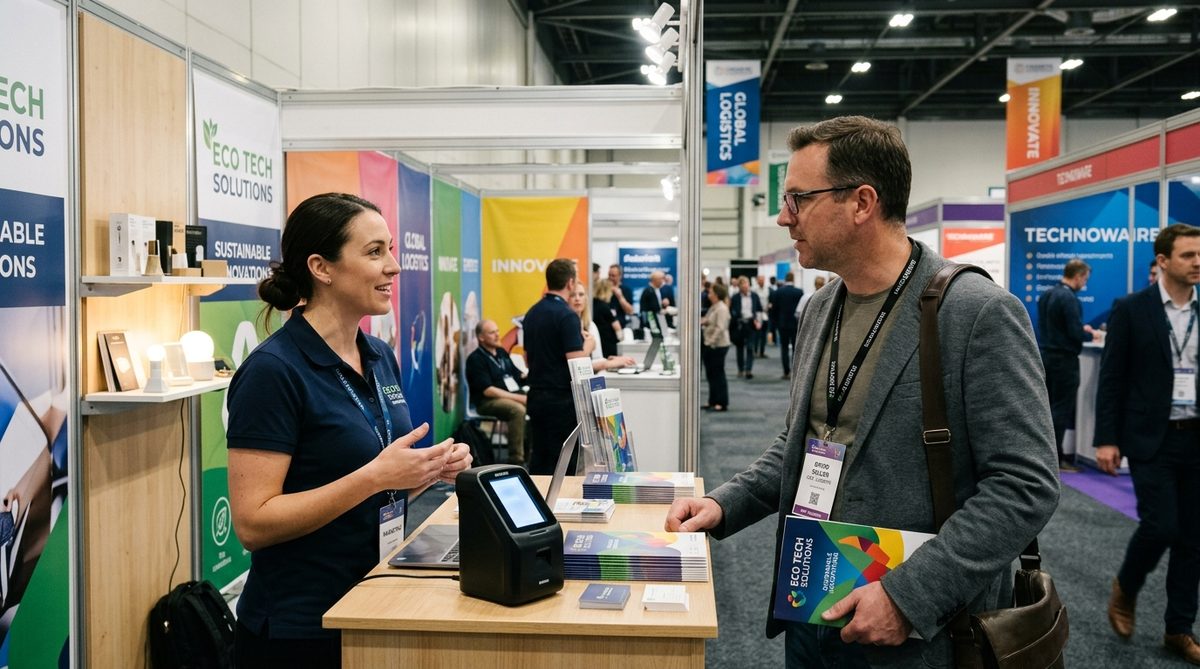
Ask a small B2B company how their last trade fair went and you will get an anecdote. “Good show. Busy stand. Met some interesting people. There’s one German distributor we’re following up.” Ask what it cost and you will get the stand price. Ask what it returned and the conversation gets vague.
This is remarkable given the numbers involved. For a company doing €3m in revenue, a mid-size European trade fair — stand, build, freight, travel, staff time — routinely runs €25,000 to €60,000 all-in. That is frequently the single largest discretionary marketing expenditure of the year, larger than the entire digital budget, and it is the one line item that is evaluated on vibes.
Trade fairs can work extremely well in B2B. In some sectors they remain the highest-yield channel there is, and no amount of content marketing replaces standing next to a machine with the person who will operate it. But “can work” and “worked, for us, last year” are different claims, and only one of them is measurable. This article is about how to measure it.
The Cost Base — Count Everything, Not the Stand
The stand fee is typically 30–40% of the real cost.
Build the full number before the show, not after. For every fair:
Direct costs:
- Space rental
- Stand design, build, and dismantling
- Furniture, power, internet, cleaning, waste
- Freight for samples and stand materials, both ways
- Printed materials, giveaways, samples
- Insurance
- Lead capture device or scanner rental
People costs — the ones nobody counts:
- Flights, hotels, per diems, local transport
- Staff days. Four people for three show days plus a build day plus travel days is roughly 24 person-days. At a fully loaded cost of €300–500 per day, that is €7,000–12,000 of your own money that never appears on any invoice.
- Preparation time. Stand design decisions, material production, target list building, meeting scheduling, briefing. Typically 10–20 person-days spread across two months.
- Follow-up time. The 40 hours after the show that determine whether any of this converts. This is a cost and it is nearly always unbudgeted, which is why it nearly always does not happen.
Opportunity cost:
- What those people would otherwise have produced in that fortnight
Run this once and the number will surprise you. A show you think cost €18,000 is usually €40,000 when the person-days go in. That does not mean don’t go. It means you now know what the show has to return to be worth it, which is the prerequisite for every other decision in this article.
Set the Target Before You Book
“Brand awareness” is not an objective. It is the answer people give when they have not set one.
Before booking, write down what this show must produce to be worth its cost. There are only a few legitimate answers, and they demand different stands, different staff, and different measurement:
- New qualified leads. A specific number. “We need 30 qualified leads” is a target. Given a typical B2B close rate and your average deal size, you can work out whether 30 is even enough to cover the cost — and sometimes the honest answer is that this show cannot mathematically pay back, which is worth knowing in February rather than October.
- Meetings with named targets. Often the real reason to go. You have 25 accounts you cannot get on the phone, and they will all be in this building for three days. This is a completely different show: you pre-book meetings, you need a quiet corner more than a flashy stand, and you measure meetings held against meetings targeted.
- Existing customer retention. Also legitimate, also invisible on a lead count. Measure it as meetings held with existing accounts and what came of them.
- Supplier or partner sourcing. You are there to buy, not sell. Different objective, different measurement, frequently the highest-return reason a small distributor attends anything.
- Market intelligence. Real, but be honest: this is rarely worth €40,000 on its own. It is a by-product, not a justification.
Pick one primary objective. A stand built to attract volume traffic is a bad stand for confidential meetings with three large targets. Trying to do both produces a stand that does neither, staffed by people who do not know which job they are doing.
Lead Qualification at the Stand — Where Most of the Value Is Won or Lost
A scanned badge is not a lead. It is a business card with extra steps.
The standard failure: three days of scanning everyone who walks past, producing 400 “leads,” of which perhaps 25 have any relevance. Two weeks later someone emails all 400 the same message, gets a 2% response, and the show is written off as a failure. The show was fine. The qualification was absent.
Qualify at the stand, in the conversation, in real time. Every scan gets a grade attached before the person walks away:
- A — Real buyer, real need, real timeline. They have a defined problem your product solves, they have budget authority or direct access to it, and something is happening in the next six months. Expect a handful across the whole show. These get a follow-up commitment made in person, with a date, before they leave the stand.
- B — Right profile, no active need. Correct company, correct role, nothing happening right now. This is the largest useful group and the one everyone mishandles by pitching. They belong on the nurture list, not the call list.
- C — Curious, adjacent, or a student. Polite conversation, no follow-up.
- X — Selling to you. Every fair is full of these. Grade them so they never enter the follow-up pipeline.
Capture three things per A and B lead, in writing, at the stand:
- What they actually said their problem was, in their words. Not a category. The sentence.
- What you agreed would happen next, with a date.
- Anything personal that makes the follow-up human. They are opening a second warehouse in Lyon. They were sceptical about the throughput claim.
That third field is what makes the follow-up email get a reply, because it proves a conversation happened. The alternative — “It was great meeting you at the fair!” — is indistinguishable from the other eleven emails they received that week and it is treated accordingly.
Brief the staff on this before the show, and make it the only metric they are judged on. A team measured on scan count will scan everyone. A team measured on graded A and B leads with real notes will have fewer, better conversations. You get the behaviour you measure, at a stand more than almost anywhere else.
The Follow-Up Window — The Two Weeks That Decide Everything
The show does not produce revenue. The fortnight after it does.
The pattern is brutally consistent: companies spend €40,000 to have the conversations, then return to a full inbox and follow up nine days later with a generic email. The prospect has now met sixty companies and remembers none of them.
The schedule, non-negotiable:
- Within 48 hours: every A lead gets a personal message referencing the specific conversation, delivering whatever was promised — the spec sheet, the quote, the sample. Not a template. Not a newsletter. Four sentences from the person who spoke to them.
- Within one week: every B lead gets a relevant, non-pushy message and an explicit invitation onto the list. Consent, recorded, with the source field marked as the show — which matters both legally and for the attribution you will do in twelve months. Our note on B2B email list building covers the consent basis for trade fair contacts.
- Within two weeks: A leads who have not responded get a second, different message. Not a chase — a new piece of value.
- Ongoing: B leads enter the normal nurture sequence, tagged by show, forever.
Budget the follow-up time as part of the show cost, and block the calendar before you go. The two weeks after a fair should be lighter than normal, not heavier. Every company schedules it the other way round, and it is the single largest destroyer of trade fair ROI in existence — more than the stand, the location, or the staffing.
Tag everything by show. Every contact carries the show name as a source field. Without this, the attribution in the next section is impossible, and you will be having the vibes conversation again next year.
Attribution — The 12-Month Window
A trade fair measured at 30 days always looks like a failure.
B2B sales cycles in most distribution and manufacturing categories run six to eighteen months. A show evaluated in the following month is being evaluated before the mechanism has had time to operate. This is why so many companies conclude fairs do not work and stop — usually right before the deals from the previous one land.
Measure at three points:
- Day 30: activity metrics only. A and B leads captured, follow-ups completed, meetings booked. This does not tell you about ROI. It tells you whether the process ran, which is the only thing you can still fix.
- Month 6: pipeline value from show-sourced contacts. Opportunities, weighted. This is the first real signal.
- Month 12: closed revenue from show-sourced contacts, plus pipeline still open. Compare to total show cost.
Attribute first-touch, and be honest about the ambiguity. If a contact was captured at the show, credit the show, even if the deal was closed through six other conversations. This overstates the fair slightly, and the alternative — multi-touch models a five-person company cannot maintain — understates it while providing an illusion of precision. Pick first-touch, apply it consistently, and compare shows to shows.
The comparison that actually informs the decision: cost per qualified lead and cost per closed euro, against your other channels. If a fair delivers a qualified lead at €900 and your content and inbound engine delivers one at €200, that is not automatically an argument to stop going — fair leads are often larger and further along, and some accounts you will never reach any other way. But it is the comparison that turns “should we do the show again?” from a preference into a decision. The economics sit alongside your other acquisition costs; the broader B2B channel picture is what makes them comparable.
Deciding Whether to Go Back
Twelve months on, with real numbers, the answer is usually one of four:
- Go back, same way. It paid. Rare on the first attempt.
- Go back, differently. The show had the right people and you executed badly — bad stand position, wrong staff, no pre-booked meetings, follow-up that slipped. This is the most common honest answer after a first show and it justifies exactly one more attempt with the specific fix named.
- Go, but not with a stand. The realisation that saves small companies enormous amounts of money. If your objective was 25 meetings with named accounts, two people with a hotel lobby and a booked diary achieves it for €4,000 instead of €40,000. No stand. No build. No freight. This is not a lesser version of exhibiting; for a meeting-driven objective it is simply better.
- Do not go back. The buyers are not there, or they are and they will not buy from a company your size, or the maths cannot work at your deal value. Write it down, with the number, so that next February when someone says “should we do Hannover again?” the answer exists.
The rule that prevents the worst outcome: never book next year’s stand at this year’s show. The early-booking discount is designed precisely to extract the decision from you while you are still in the atmosphere of a busy hall and before any of the leads have failed to convert. The discount is 10%. The cost of a wrong decision is the whole budget.
Trade fairs are not a marketing channel that either works or does not. They are a channel with a very high fixed cost, a very long payback, and an execution requirement concentrated in two weeks that most companies do not staff. Which means the same show, same hall, same buyers, will return three times the money for the company that graded its leads and followed up in 48 hours than for the one that scanned 400 badges and emailed them all a newsletter in October.
Count the full cost. Set one objective. Grade the leads at the stand. Block the fortnight afterwards. Measure at twelve months against your other channels. Do that for one show and you will know something almost none of your competitors know: what the thing actually costs, and what it actually returns.
Sources: ICC — International Chamber of Commerce · European Commission — Internal Market and Industry