
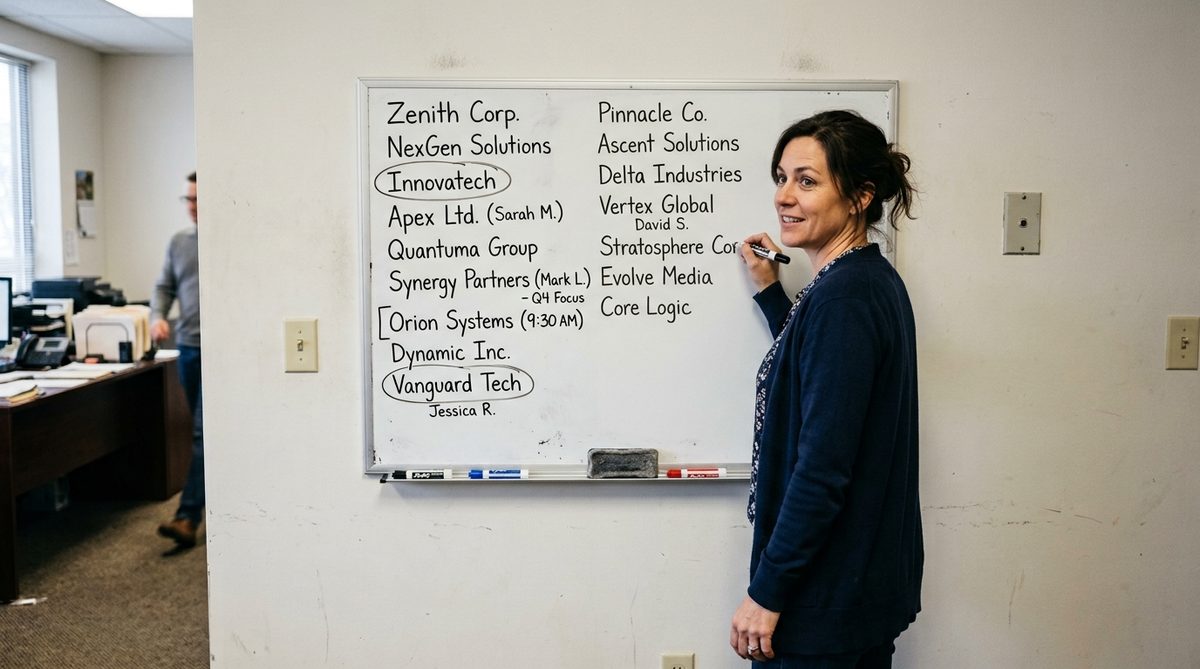
Account-based marketing has a positioning problem. It’s sold as an enterprise discipline — six-figure platforms, intent data subscriptions, dedicated ABM teams, orchestrated multi-channel campaigns against 500 target accounts. All of which is real, and none of which is available to a company with two people doing marketing and sales between them.
The irony is that ABM’s underlying logic suits small teams better than it suits enterprises. The whole idea is to stop broadcasting and start treating a small number of specific companies as markets of one. A two-person team is structurally incapable of broadcasting effectively anyway — they can’t outspend anyone. What they can do is know forty companies extremely well, which is something a 200-person marketing department genuinely struggles to do.
The constraint isn’t budget. It’s that most small teams run “ABM” as a mail merge with the company name in the subject line, get a 2% reply rate, and conclude ABM doesn’t work for them.
Account Selection — The Decision That Determines Everything
Get the list wrong and no amount of execution saves you.
Every hour you spend on the wrong account is an hour not spent on the right one, and with a two-person team you have maybe 30 useful account-hours a month. Selection is not a preliminary step. It is most of the work.
Build the list from evidence, not aspiration. The temptation is to list the companies you’d like as customers — the big logos. Those are usually the worst ABM targets for a small firm, because your lack of scale is most visible exactly where procurement is most rigorous.
Start from your best existing customers.
Take your five most profitable, longest-retained, least-painful customers. Not your biggest — your best. Then find what they share. Look past the obvious firmographics:
- Structural triggers — did they all buy within 18 months of a specific event? A new ops director, a system migration, entering a new market, hitting a size where a spreadsheet stopped working?
- The pain’s location — which specific role felt the problem? Not “the company needed X” but “the finance manager was doing X manually every Friday.”
- Why they chose you over the alternative — ask them. Directly. The answer is almost never what you think, and it’s the single highest-value input into your selection criteria.
- What they’d have bought if you didn’t exist — this tells you the real competitive set and the real budget line.
That’s your ideal customer profile, built from evidence. Now the list is companies that match those structural characteristics, not companies that match your revenue fantasies.
Size the list to your actual capacity.
The arithmetic is brutal and worth doing:
- Real ABM research is 2–3 hours per account, once.
- Ongoing engagement is roughly 1 hour per account per month.
- With one person at 50% on ABM, you have about 80 hours a month.
- That supports roughly 40–50 accounts in steady state, with room for research on new ones.
Forty accounts. Not four hundred. If your list is longer than your capacity, you’re not doing ABM — you’re doing outbound with extra steps, and the personalisation will be shallow enough that recipients notice.
Tier within the list.
- Tier 1 (5–10 accounts) — one-to-one. Genuinely bespoke. Custom research, tailored materials, multiple stakeholders mapped. 3+ hours each per month.
- Tier 2 (20–30 accounts) — one-to-few. Clustered by a shared characteristic (same sub-industry, same trigger event). Materials are shared across the cluster with light per-account tailoring. 1 hour each per month.
- Tier 3 (the rest) — one-to-many. Segment-level content, no per-account work. This is just good marketing, correctly labelled.
Most teams should have almost no Tier 1 accounts at the start, because Tier 1 only pays back on deals large enough to justify 40 hours of work. Be honest about your deal size.
The Research That Actually Changes the Conversation
Firmographics are table stakes and convince nobody.
“I saw you’re a €20M distributor in the Rhine-Ruhr region” tells the recipient you can read a database. It is not research. It’s the ABM equivalent of “I hope this email finds you well.”
Useful research finds something the recipient believes is not publicly obvious. Sources that produce that:
- Job postings. The most underrated signal in B2B. A company hiring three warehouse ops roles and a demand planner is telling you their fulfilment is straining. A posting that lists your competitor’s software in the requirements tells you their stack.
- The company’s own content. Their annual report’s risk section. Their LinkedIn posts. A webinar their ops director did in March. People state their problems publicly and then are amazed you noticed.
- Their customers’ complaints. Reviews of their product, not yours. If their buyers complain about lead times, you know where the pressure is.
- Leadership changes. A new director in the function you sell to has a 90-day window where they’re expected to change something. This is the highest-conversion trigger in B2B, and it is free to monitor.
- Regulatory or trade shifts affecting their specific sector. If you know a rule change lands in their market next quarter and they haven’t mentioned it, that’s a conversation.
The output of research is one sentence.
All that work produces a single specific observation you can lead with. Not a paragraph — a sentence a busy person reads in three seconds and thinks “how do they know that.”
Weak: “I noticed you’re growing in the DACH region and thought our solution might help.” Strong: “You’ve posted three demand-planning roles since March and none are filled — I’m guessing the planning load moved to your ops manager.”
The second one might be wrong. That’s fine — being wrong specifically gets a correction, which is a conversation. Being vague gets nothing.
Map more than one person.
B2B purchases involve multiple people, and the one who feels the pain is usually not the one who signs. For Tier 1 and Tier 2 accounts, identify at least three:
- The pain-holder — feels the problem daily. Your best entry point and worst closer.
- The economic buyer — controls the budget. Cares about a different thing entirely.
- The blocker — IT, finance, procurement, or whoever inherits the risk. Find them early. Deals die here silently.
You don’t need to contact all three at once. You need to know they exist, so you’re not surprised in month three when a name you’ve never heard of kills the deal.
Channel Sequencing on No Budget
Warm before you write.
Cold outreach to an account that’s never heard of you converts at low single digits regardless of personalisation quality. The fix is cheap: create familiarity before the ask.
A workable four-week sequence per Tier 2 account, costing near zero:
- Week 1 — Ambient. Follow the mapped contacts. Engage genuinely with one or two of their posts — a comment that adds something, not “great post.” They now recognise your name and photo.
- Week 2 — Value, no ask. Send the research observation with something useful attached and no call to action. A relevant regulation summary. A short note on what three similar companies did. The absence of an ask is the mechanism — it’s disorienting in a good way.
- Week 3 — The specific ask. Short, one question, reply-based. Not a calendar link. “Is the planning load actually sitting with your ops manager, or did I read that wrong?”
- Week 4 — Different channel, different angle. If email got nothing, try LinkedIn. If you sent to the pain-holder, try a peer. Do not repeat the same message louder.
Then stop, and re-enter later.
Four touches and no response means not now. Move the account to a nurture segment and re-enter in six months or on a trigger event. The fifth, sixth, and seventh follow-up email do not convert; they burn the account and your domain reputation. The trigger-based re-entry converts far better than persistence, because the reason they ignored you was usually timing.
The channels that work without spend.
- LinkedIn, used as a research and warming tool rather than a broadcast one. The organic reach question is separate — see the LinkedIn strategy for B2B consultants for the content side.
- Email, with authentication done properly. If your SPF and DKIM aren’t right, none of this matters because you’re in spam. The Brevo setup guide covers the authentication sequence.
- Physical mail, genuinely. It’s near-dead, which is exactly why it works. A printed one-page analysis of the recipient’s specific situation costs €3 and gets opened at rates email cannot approach. Reserve for Tier 1.
- Referral paths through your existing customers into their peers. The highest-converting channel there is, and the one small teams systematically under-ask for.
The channel that doesn’t work: paid ads against a 40-account list. The minimum spend to reach 40 companies’ worth of individuals with any frequency is disproportionate to the reach, and you’ll spend €800 to put an impression in front of someone you could have emailed for free. Retargeting your list is fine once they’ve visited. Cold paid ABM at this scale is not.
Measuring ABM Without Fooling Yourself
Volume metrics are actively misleading here.
Open rates, click rates, impressions, “engaged accounts” — all of these go up when you personalise, and none of them predict revenue. A 60% open rate on 40 emails is 24 opens. It’s not a result.
The honest ABM metrics:
- Account penetration — how many of your mapped contacts at each target account have engaged at all. Two contacts engaged at one account beats one contact at two accounts, because B2B deals need internal advocates.
- Meetings from target accounts — the only leading indicator that reliably predicts pipeline.
- Pipeline from the named list vs. everything else — the comparison that actually answers “is ABM working.”
- Deal velocity on ABM accounts vs. inbound. ABM deals should close faster because you did the qualification work upfront. If they don’t, your selection is wrong.
- Time per account per outcome. The number nobody tracks and everybody needs. If a Tier 1 account consumed 40 hours and produced nothing, that’s a €2,000 experiment and it should inform the next list.
Give it four quarters before judging.
ABM’s cycle time is long. A 40-account list with a 6-month average sales cycle produces almost no signal in the first two quarters. Teams that kill ABM at month four are killing it before any data exists — they’re reacting to the absence of the vanity metrics they’d have got from a broadcast campaign.
Set the review point at four quarters. What you’re looking for at that point: did named accounts produce pipeline at a materially better rate per hour than the alternative use of those hours? If yes, expand the list. If no, the problem is almost certainly selection, not execution.
Keep the account record somewhere real.
All of this collapses if the research lives in one person’s head or in a document nobody opens. Each account needs a record: the research, the mapped contacts, every touch and its date, the trigger you’re waiting on. This does not require an ABM platform. It requires a CRM you actually update — even a minimum viable CRM handles a 40-account list comfortably. The failure mode is the spreadsheet that’s three months stale, which is worse than nothing because you’ll act on it.
ABM for a small team is not a scaled-down version of enterprise ABM. It’s a different thing that shares a name. Enterprise ABM is about coordinating many people against many accounts. Small-team ABM is about one or two people knowing forty companies well enough to say something true and specific — which is a capability that gets harder as organisations grow, not easier.
That’s the actual advantage, and it’s worth being clear-eyed about it: you will never outspend the incumbent, and you don’t have to. You have to know the customer’s situation better than the incumbent’s account manager does, and then say so, to the right person, in the quarter when it matters.
Sources: LinkedIn Marketing Solutions — account-based marketing · Gartner — the B2B buying journey