
Most small importers choose their freight forwarder badly, and the reason is structural rather than careless. You need a forwarder before you have the volume that makes forwarders interested in you. So you take the one who answered the phone, or the one your supplier recommended — which is a conflict of interest nobody names out loud — and you stay with them for six years because switching feels harder than complaining.
Then a container sits in Rotterdam for eleven days over a customs classification your forwarder never flagged, and you discover that the €180 you saved per shipment against the alternative quote was not the relevant number.
Freight forwarding is a service business where price differences between competent providers are small and the difference between competent and incompetent is enormous. The whole selection problem is figuring out which one you’re being offered, before you find out the hard way.
What a Forwarder Actually Does — and What They Don’t
They’re an intermediary, not a carrier.
A freight forwarder does not own the ship, the plane, or usually the truck. They buy capacity from carriers in bulk and resell it to you, and they arrange everything around the movement: booking, documentation, customs, consolidation, insurance placement, and the phone calls when something goes wrong.
This matters for two reasons. First, on the trunk leg they’re all buying from roughly the same carriers, so the space itself isn’t where they differ. Second, their actual product is coordination and problem-solving — which is invisible in a quote and only observable under stress.
The service tiers, which are rarely explained.
- Freight forwarder — arranges and coordinates. May or may not handle customs directly.
- Customs broker — licensed to clear goods. Some forwarders have this in-house; others subcontract it, which adds a handoff and a place for things to fall.
- NVOCC — a forwarder that issues its own bills of lading and takes on carrier-like liability. Relevant to you because it changes who you have recourse against.
- 3PL — forwarding plus warehousing and fulfilment. Different business, often oversold to importers who need forwarding.
Ask directly which of these your candidate is, and specifically whether customs clearance is in-house. In-house clearance is a meaningful advantage for small importers because the classification question and the movement question get answered by the same organisation.
What they are not responsible for.
Read this carefully, because it’s the source of most disputes. Under standard forwarding conditions, the forwarder is generally not liable for the goods themselves in the way a carrier is. Their liability is typically capped — often by weight, at levels far below cargo value — and their standard terms disclaim consequential loss entirely.
Your forwarder losing your container does not make you whole. Cargo insurance does. Confusing the two is the most expensive misunderstanding in small-scale importing.
The Questions That Separate Real Capability from a Website
Ask about your specific lane, not their network map.
Every forwarder’s website shows a world map with lines on it. Meaningless. The question is whether they move freight on your lane, regularly, with their own relationships.
- “How many shipments did you move on this exact lane in the last quarter?” A specific number means real volume. “We’re very strong in that region” means they’ll subcontract it.
- “Which carriers do you have contracted rates with on this lane?” Named carriers, not “all major lines.”
- “Who is your agent at the destination, and how long have you worked with them?” The destination agent is who actually solves your problem at 2am local time. A forwarder with a weak destination agent is a weak forwarder on that lane, regardless of how good their head office is.
Ask about failure, specifically.
Anyone can quote a smooth shipment. Ask:
- “Walk me through the last shipment on this lane that went wrong. What happened, and what did you do?” A forwarder who says nothing ever goes wrong is either lying or has no volume. A good answer is detailed, slightly rueful, and includes what they’d do differently.
- “If my container is held at customs, who calls me, how fast, and what do they tell me?” You’re testing whether there’s a named person or a shared inbox.
- “What’s your process when a vessel rolls my container?” Rolling — where the carrier bumps your box to a later sailing — is routine and the forwarder’s response to it is highly variable.
- “What happens outside your business hours?” Ports do not keep office hours.
Ask about compliance, because their exposure is yours.
Your forwarder is in your transaction chain, which means they’re in scope for your own screening. Ask what their sanctions and dual-use screening process is, whether they screen the parties on the shipment themselves, and whether they’d flag a classification concern proactively or just move what you told them to move.
The right answer is that they screen and they’d stop the shipment. If their answer is “we just move what you book”, you are carrying all of the risk and none of the expertise — and you should be running your own sanctions screening workflow regardless.
Check the credentials that are checkable.
- FIATA membership — the international forwarders’ association. Not a guarantee of quality, but it’s a filter and members subscribe to standard trading conditions.
- AEO status (Authorised Economic Operator) — an EU customs certification that brings genuinely faster clearance and fewer inspections. For an EU importer, an AEO forwarder is worth real money in reduced delay.
- Cargo liability insurance — ask for the certificate, not the assurance.
- National licensing for customs brokerage in the clearing country.
Comparing Quotes Without Being Fooled
The all-in number is the only number.
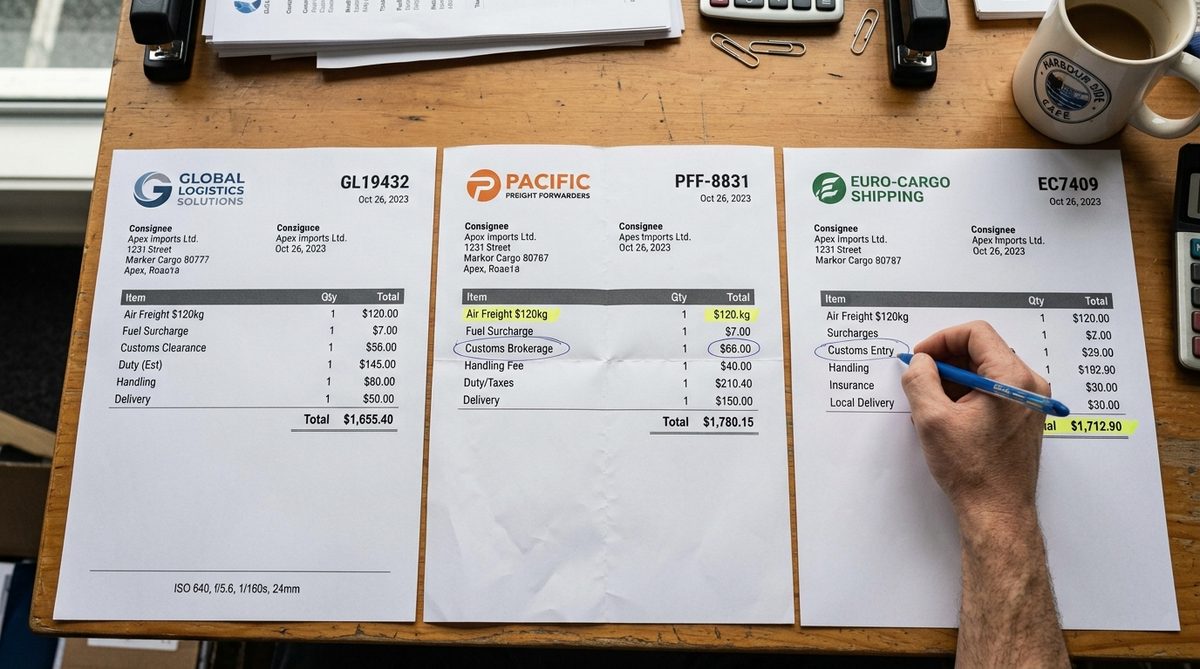
Forwarder quotes are structurally designed to be incomparable. One quotes port-to-port and one quotes door-to-door. One includes THC and one doesn’t. The headline ocean freight rate is the smallest and most-advertised component.
Demand a written all-in quote for the actual door-to-door movement, itemised, with every line named. Then check that these are all present:
- Ocean or air freight (the headline number)
- Origin charges: pickup, export customs, terminal handling at origin
- Destination terminal handling (THC) — routinely omitted, routinely material
- Import customs clearance fee
- Duty and VAT — usually disbursed, sometimes with a percentage fee on top of the disbursement, which is worth catching
- Delivery to your door
- Documentation fee, B/L fee, ISF/ENS filing
- Currency adjustment factor and bunker adjustment factor, if applicable
The charges that appear after you’ve committed.
Ask explicitly what is not in the quote. The predictable additions:
- Demurrage and detention — charges for keeping the container at the terminal or off-terminal too long. These accrue daily, they’re large, and they’re usually your problem even when the delay wasn’t your fault. Ask how many free days you get and what the daily rate is after. This single question separates forwarders who are managing your risk from ones who are managing their margin.
- Customs examination fees — if your box gets pulled, you pay for the inspection.
- Storage at the destination if you can’t take delivery.
- Peak season surcharge and general rate increase — carriers impose these; the question is whether the forwarder passes them at cost or marks them up.
Fixed price versus pass-through.
Two commercial models, and the choice matters more than the rate:
- Buy-sell — the forwarder quotes you one number and keeps the spread. Simple, predictable, and you have no visibility into what they paid.
- Cost-plus / open book — you see the carrier’s actual rate and pay a defined handling fee. Transparent, usually cheaper at volume, and it aligns their incentive with yours because they don’t profit from a higher rate.
Below roughly 50 containers a year, buy-sell is normal and fine. Above that, ask for open book and watch how they react — the reaction is informative.
The currency question.
Ocean freight is frequently denominated in USD even for EU-to-EU-adjacent movements. If your quote is in USD and you’re paying in EUR, you have an FX exposure on every shipment that nobody mentioned. Ask which currency the invoice will be in and what rate they apply. A forwarder converting at their own rate with an undisclosed spread is charging you a second, invisible fee. This connects directly to FX risk management for B2B importers — freight is often the exposure people miss because they’re watching the goods invoice.
Contract Terms and the Incoterms Interaction
Your Incoterm determines what you’re even buying.
Before you can compare forwarder quotes, you need to know where your responsibility starts. If you’re buying EXW, you need the forwarder to handle everything including export clearance at origin — which is genuinely difficult in some jurisdictions and is why EXW is often a worse deal than it looks. If you’re buying DDP, you barely need a forwarder at all and you’re paying your supplier a margin to arrange one.
The sweet spot for most small importers is FCA or FOB: the supplier gets the goods to a named point and clears export, and your forwarder takes it from there. That gives you control of the main leg — which is where the cost and the choice actually are — without inheriting the export clearance problem in a country you don’t operate in. The Incoterms mechanics for EU trade go deeper on where the risk transfers.
Get the Incoterm settled with your supplier before you brief forwarders. Otherwise you’re comparing quotes for different scopes of work.
Terms to fix in writing.
- Trading conditions — which set applies (FIATA model rules, national association conditions, or their own). Read the liability cap. It will be lower than you expect.
- Payment terms — 30 days is standard once you have a credit account. Prepayment on the first few shipments is normal.
- Rate validity — how long the quote holds. Ocean rates move; a quote valid for 7 days is honest, one valid for 12 months is fiction with a surcharge clause attached.
- Cargo insurance — arrange it, and be clear whether it’s through the forwarder or your own broker. All-risk cover at 110% of CIF value is the convention. This is not optional and it is not what their liability cover does.
- Notice period to terminate — keep it short. 30 days.
Don’t sign an exclusivity or volume commitment early.
A forwarder offering a better rate for committed volume is offering you a real discount and a real risk. Until you’ve watched them handle a problem, you don’t know what you’ve bought. Run them non-exclusively for two or three shipments first.
Running Two, and Knowing When to Switch
Single-source is the default and it’s a mistake.
Almost every small importer uses one forwarder, because managing two feels like double the admin. The cost of that is invisible until it isn’t: no rate benchmark, no fallback when they’re capacity-constrained in peak season, and no leverage in any conversation.
Running a primary at 70–80% of volume and a secondary at 20–30% costs very little extra effort and buys you a live price check, a tested backup, and a materially different negotiating position. The secondary doesn’t need to be big. It needs to be real and recently used.
Measure them on things other than rate.
Track per shipment, per forwarder:
- Transit time actual vs. quoted — and specifically the variance, not the average. A forwarder with a 32-day average and a 4-day standard deviation is better than one with a 30-day average and a 12-day standard deviation, because you can plan around the first.
- Invoice accuracy — percentage of invoices matching the quote with no unexplained additions. This is a proxy for organisational honesty and it’s remarkably predictive.
- Demurrage incurred — and whose fault it was.
- Response time on exceptions — hours from problem to first substantive contact.
- Documentation errors — wrong B/L details, late ISF, missing certificates. Each one is a delay waiting to happen.
Six months of this data turns your next negotiation from an argument into a conversation about specific numbers, which you will win.
The switching triggers.
Switch when you see: repeated invoice surprises after you’ve raised it once; a problem where nobody called you and you found out from the terminal; consistent transit variance you can’t plan around; or an unwillingness to answer the open-book question at a volume where it’s reasonable.
Don’t switch over a single bad shipment. Freight goes wrong; the test is the response. Do switch when the response to a bad shipment is a shrug and an invoice.
Choosing a forwarder is one of the few procurement decisions where the cheapest option and the best option diverge sharply and the divergence is invisible at the point of decision. The €180 rate difference is knowable in advance. The eleven days in Rotterdam are not.
The practical approach: shortlist three who genuinely run your lane, ask them the failure questions rather than the capability questions, get all-in itemised quotes, start non-exclusively, measure invoice accuracy and transit variance for two quarters, then commit volume to whoever earned it. The selection isn’t the decision you make in week one. It’s the one you make in month six, with data.
Sources: FIATA — International Federation of Freight Forwarders Associations · European Commission — Authorised Economic Operator (AEO) · ICC — Incoterms rules